
Article
Good afternoon, senior class of 2026!
Tomorrow is a very special day. You will be joining a solemn ritual that has taken place here at Harvard for 370 years. Commencement ceremonies are formal and ritualistic, for good reason. A little bit of ritual breaks us out of routines and says to our brains – "this is something worth remembering, so soak it in." That's the upside. The downside is that it's elaborate and confusing, and you've never done this before. So let me be your tour guide.
Here's the first question – why do we call it commencement, rather than graduation? You are graduating, after all. Tomorrow marks the end of your time as a Harvard student. But the word commencement comes from the Latin verb cominitiare, or "to begin". As in "let the games commence". Or, "'gainst myself a lawful plea commence" if you're a Shakespeare nut.
That's confusing! But it's called commencement because your education is supposed to prepare you to begin your journey as a citizen of the wider world. Your term of private study has ended. Now begins your public responsibility. That's why the words on the Dexter Gate behind Widener Library say "enter, to grow in wisdom; depart, to better serve thy country and thy kind." Commencement is the University declaring that you are ready to report for duty. Or more crudely, "you don't have to go home, but you've got to get the heck outta here."
The day starts with something we call Morning Exercises. The ceremony begins with the University Marshal asking the sheriff of Middlesex county "Mr. Sheriff, pray give us order." The sheriff then strikes the Dais three times and rather dramatically declares the meeting in order.
Why does the sheriff attend? Well, according to Samuel Batchelder's book "Bits of Harvard History", commencement used to be raucous. In 1703, the relatively small number of graduates and their guests collectively consumed 14 barrels of beer, 18 gallons of wine, and one barrel of cider. During President Wadsworth's tenure from 1725 to 1737, the Corporation kept the exact date of Commencement a secret until a week or two in advance to keep the crowds down, and scheduled it on Friday "so that the rest of the week would not be consumed with Saturnalia." They then moved it to Thursday to accommodate "the country clergy, for whom a Friday commencement gave insufficient time to sober up and get home for the Sabbath." So, Thursday it is.
In 1797, a live elephant was brought to Commencement, along with people dressed as mermaids and mummies. You can see why a Sheriff was needed to give order.
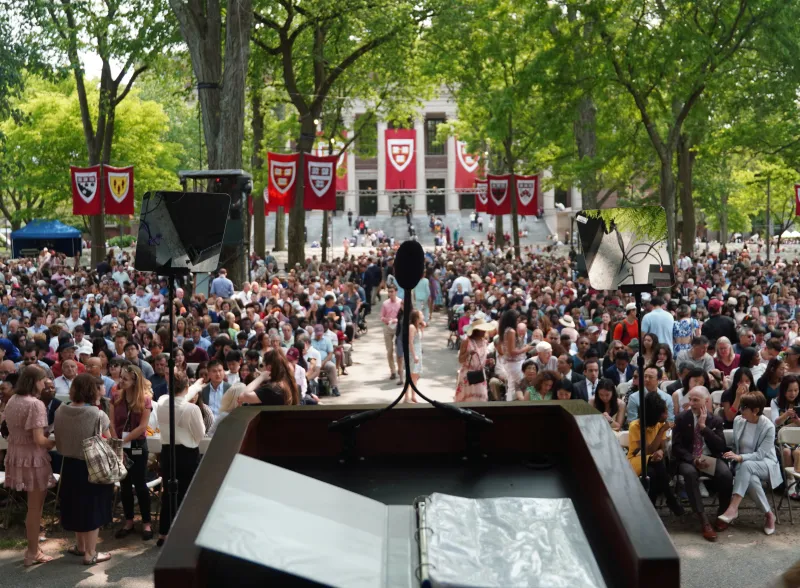
Tomorrow's comparatively sober affair will occur right here in Tercentenary Theatre (which was named as such in 1936, for the 300th anniversary of the university's founding), where President Garber will confer the degrees upon the University's graduates. First the PhDs and Masters degrees will be called.
Then the professional schools will be acknowledged, in the reverse order of their founding dates. Each school will offer their own cheers and be waving their symbols in the air.
Then, finally, the most important moment of the entire ceremony will occur: The College—as the oldest and original part of this University—will be called forth. Then, we will get a chance to top them all. And of course, you'll sit solemnly, taking in the occasion. You won't cheer at all, right? Right?
Once you've expressed yourselves completely, I will turn to President Garber, the Fellows of the Harvard Corporation, and the Board of Overseers, and announce that you have fulfilled the faculty's requirements for the first degree in Arts and Sciences. Finally, I will pronounce that "each candidate stands ready to advance knowledge, to promote understanding, and to serve society." In other words, I will pronounce that you have fulfilled the mission of Harvard College and are ready to go forth and become the citizens and leaders of our society.
Your families and loved ones will cheer enthusiastically, and their hearts will burst with pride on your behalf. It will be a joyous and memorable occasion.
Most of you came to this campus in 2022, and a lot has happened since then here at Harvard and in the wider world. The world you thought you knew when you came here suddenly feels uncertain, maybe even precarious.
I'm sure you've seen this trend around the country where old guys—usually guys—tell graduates about the wonders of artificial intelligence and get lustily booed. I hope you don't boo me today, but if you do, I could kind of understand why. Commencement speeches usually take the form of "successful, established person imparts wisdom to college grads that makes them feel hopeful for the future."
This kind of breezy advice can ring hollow when the world feels so uncertain, especially for young people who are just getting started. It must be annoying to hear a self-assured boomer tell you how you should adapt to a changing world. (Sidebar - I'm 47, please don't call me a boomer. My parents are boomers.)
So I'm not going to give you any advice today. I'm just going to tell you a story. And I hope the story makes you think or at least entertains you a little.
I was a real pain in the neck when I was in high school. I refused to listen to what my parents said about anything. (Maybe this sounds familiar to some parents in the audience?) I was not the genteel statesman you see before you today. So when I turned 18 my senior year, my dad said "ok, you're an adult, no more curfew, no more telling you what to do. But also... no more money."
To be fair to my parents, they didn't have a ton of disposable income, I had a younger brother, and I had gotten a full scholarship to attend The Ohio State University, so they figured "he's good."
So I hustled for money. I painted windows, I washed cars, I sat middle seat in a pickup truck mowing lawns and weeding east Cleveland homes in the sweltering heat. I worked briefly as a singing waiter at the Macaroni Grill. I spent a summer installing air conditioning louvers on a Holiday Inn in Ft. Wayne, IN.
These were... not good jobs. Sure—I learned the value of hard work—but that lesson wore out pretty quickly. I learned how to drive a cherry picker, which was fun, but I can't say it was useful in my later life as a Dean, unless anyone needs me to retrieve a frisbee from the Memorial Church roof.
Remember this was before cell phones, so I spent a lot of time at work lost in thought. "Just wait until I get my college degree," I thought. "Then I'll make some real money."
Wrong.
I'm a child of the 1990s. We wore Nirvana T-shirts unironically. This was the period after the Cold War, when the US was a peaceful and economically dominant superpower, fearlessly leading a globalizing world into the 21st century. The vibes were what Francis Fukuyama called "the end of history", when liberal democratic values seemed to triumph over political, ideological, and ethnic conflict. To illustrate, the 2000 presidential debates featured a long discussion about bipartisan fixes to social security. Snooze-fest. The candidates were arguing over how to spend a Federal budget surplus, which seems hard to believe in hindsight.
Then the 2000 election happened. Bush v. Gore tore the country apart, and I learned more than I ever wanted to know about "hanging chads" (look it up). Then 9/11 happened, we went to war in Iraq, and "the end of history" turned into a period of profound political instability. In the middle, we experienced a massive runup of tech stocks from 1995 to 2000, followed by a huge crash over the next two years, which only in hindsight was called the "dot com bubble".
By the time I graduated from college in 2002, the world felt turned upside down. The unemployment rate for new college grads had doubled in the span of a year. The news was full of articles about empty career fairs and panicked college graduates unable to find work. Hiring projections for consulting firms were down 90 percent. And I was unemployed.
I spent the summer after graduation looking for work. I wanted to move to DC, but I had no money. Again. After college I was so hard up for cash that I worked as a telemarketer, hawking magazine subscriptions over the phone to make rent money. "I'm glad to hear you've had such a great experience with Good Housekeeping - but you really ought to try the Ladies Home Journal"... "you love Car & Driver, but have you considered Popular Mechanics to get the kids interested in autos too?"
After a few months I landed a job at a temp agency in DC, which placed me in a paralegal position at a big law firm on a 3-month contract. With good job performance, I converted it to a full-time position.
OK, this is the part of the story where I tell you about how all these strange jobs and setbacks helped me learn important skills like resourcefulness, resilience and hustle, and that they were blessings in disguise.
Wrong... again. It was super stressful. I felt like a failure. The most valuable thing I learned that year was that I didn't want to be a lawyer. Which is a shame, because people are always saying that Harvard needs more lawyers.
I had taken the LSAT my senior year of college, intending to apply straight to law school because I couldn't get a job (law school apps skyrocketed that year, so others had the same idea). But something made me pause, and when the paralegal job materialized, I thought, maybe if I take this I'll get some insight into the legal profession. That turned out to be my first lucky break, because I discovered that I didn't enjoy law and I wasn't that good at it. Thinking I might instead want to work in the public sector, I enrolled in a graduate program in public policy at UC-Berkeley, mostly because I'd always wanted to go to California. There I met a fiercely intelligent, principled, and beautiful young woman named Janine who I later suckered into marrying me. Second lucky break. I also landed a summer internship analyzing data for an HIV prevention program at the Baragwanath Hospital in Soweto, South Africa and discovered my love of quantitative research and data analysis. Third lucky break. I was planning to apply to federal government jobs, but when I came back from South Africa a few of my professors said, "hey you seem to like research, have you ever thought about getting a PhD?", and I said "I dunno, maybe" and then I applied to a few programs, was somehow admitted to the Kennedy School, and the rest is history.
This sounds like a pretty boring story, and maybe that's all it is. But that is my point. A slow start, a little bit of adversity, a bunch of odd jobs, and some lucky breaks... over time, can still add up to something interesting.
I could stand here and tell you that my early struggles helped me build skills and character and grit that got me to where I am today. But that's survivorship bias. It's like taking financial advice from someone who won the Powerball lottery. The truth is that many people in my shoes wouldn't have been so lucky. So, I'm not going to wish adversity on any of you. I hope that every day in your life is as sunny and beautiful and full of possibility as this one.
But, if you do get off to a slow start, or encounter some dark clouds, I want you to know that there is a silver lining. I think my early experiences made me a little less self-assured, a little more empathetic to people who weren't fortunate enough to catch so many breaks. I think it made me more aware of how much luck is required to achieve success - not just in my life, but in all of our lives.
Adversity doesn't help you economically. But it can build moral character. And the world needs moral character now, more than ever. You don't want to be the kind of person who thinks they deserve everything good that happened to them, who mistakes a tailwind for talent. The kind of person who is standing on third base and thought they hit a triple.
Having experienced the feeling that "hey, maybe it's NOT all going to work out, maybe there isn't a happy ending" makes you feel even more grateful when it does, and less sure of the inevitability of your own success.
But... but... I DO wish you success. I just don't care how much money you make.
(Although if you do make money, I hope you'll consider a gift next year to the Housing Day Challenge. Unless you're Adams, in which case maybe sit this one out.)
I want you to flourish, seniors. That means financial success and happiness of course, but also to have purpose, to have integrity, and to cultivate deep, loving relationships. These are moral virtues that are more easily developed through hardship. The easier time you have climbing the career ladder, the more difficult moral flourishing becomes, because tailwinds and lucky breaks can trick you into thinking you earned every good thing that ever happened to you.
Tomorrow you will graduate from Harvard College. But more importantly, you will commence. Commencement is not the university saying "you are finished", but rather, "you are ready". Ready doesn't mean you have it all figured out, but rather, that you have grown in wisdom and that you are prepared to better serve your country and your kind. The world needs your talent. But even more, it needs your moral courage, and your character. May you be successful, but never smug. May you be ambitious but never entitled. And if you get some lucky breaks, and I really hope you do, be wise enough to know it.
Congratulations Class of 2026, farewell, and good luck!