
Article
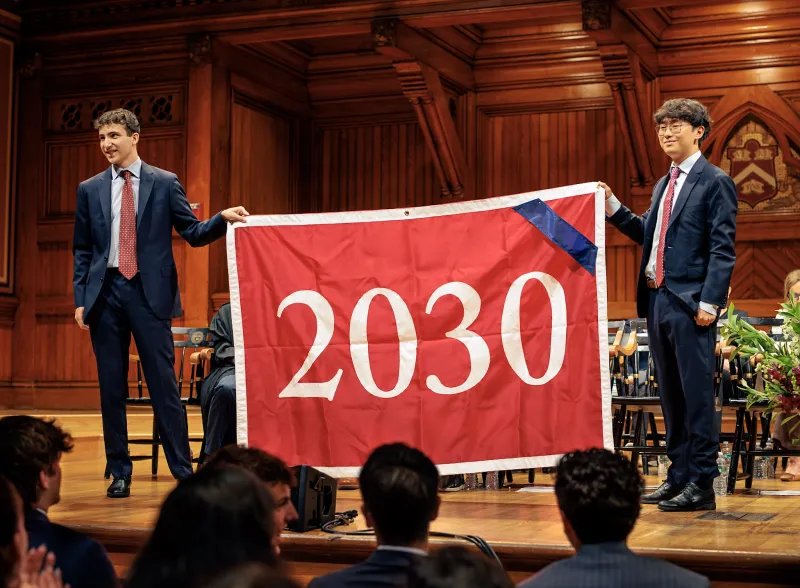
Hello, Class of 2030!
On behalf of the faculty and staff, it is my sincere honor to welcome you to Harvard College, and to the beginning of an incredible four years and – just as important – a lifetime affiliation with this incredible community.
You have all worked hard, and in many cases you and your families made tremendous sacrifices, to bring you to this place. And now, the moment has arrived. And I have a very simple question:
Why are you here? What is the purpose of a university like Harvard? What are we trying to accomplish?
For most of the life of this great university, the answer has been blindly obvious. However, over our nearly 400-year history the answer hasn’t always been the same. There have been two eras of undergraduate education in the American university. I believe the third era is beginning now, and that we will need to adapt to continue delivering an excellent education and producing graduates that serve society. I believe we will, and I hope you are as excited as I am to be a part of it.
In the first era, Harvard was the keeper of scarce knowledge. John Harvard bequeathed half of his fortune and his entire library of 400 books to establish this university. 400 books doesn’t sound like a lot, but it was rare at the time. For perspective, the entire library of Emmanuel College at Cambridge, Harvard’s alma mater, was only about 600 books in 1637. So, John Harvard gifted a founding library to us that was two-thirds the size of the library of an established British university.
Harvard didn’t have a financial endowment at that time. But the historian Samuel Eliot Morison estimated that the value of Harvard’s library in 1664 was about 9-10 shillings per volume, which means John Harvard’s contribution was probably worth something like 180 pounds. Again, that doesn’t sound like a lot. But imagine that the Harvard Management Company, which runs our endowment, had invested 180 pounds in 1638 – 388 years ago. And imagine that it earned the same return – about 7 percent, adjusting for inflation – that it’s earned over the last 50 years. John Harvard’s collection today would be worth $4 quadrillion dollars. That sounds like a fake number, but it’s not. It’s $4 trillion trillions. We missed the boat on that one, guys.
So in a very real sense, John Harvard’s collection was our first endowment. But it was knowledge capital, not financial capital. And we guarded these assets jealously. According to the library rules of 1667, only overseers, fellows, and seniors in the college could borrow books without the President’s permission. More than that, Harvard, in this time, managed access to the means of creating new knowledge. The first printing press in the American colonies was held in President Henry Dunster’s house in Harvard Yard, and for nearly 40 years it was America’s only printing office. Later, when a terrible fire destroyed most of our library in 1764, the Harvard Corporation told students “don’t come back to class”. In those days, much of Harvard’s value was in the access it provided to scarce knowledge. Without our books, it wasn’t worth being here.
Since then, Harvard’s leaders have grappled with the changing role of the university in a world where knowledge has proliferated rapidly, and the walls shielding it from the outside world are crumbling down.
When Charles William Eliot became president in 1869, the Harvard College curriculum was a narrow body of classical knowledge. Eliot would go on to create the modern elective system. President Lowell created concentrations and said in his inaugural address that “The best type of liberal education in our complex modern world aims at producing men who know a little of everything and something well.”
This second era called on Harvard to curate and develop expertise. A book contains knowledge. An expert organizes knowledge toward a purpose and helps students sift through what Lowell called the “unending stream” of information flowing past us.
Over the 20th century, the university became much more specialized, which greatly expanded intellectual life at Harvard. But it also fragmented us. Expertise makes you deep, but narrow. We see this outside the academy, where society requires ever-greater reliance on the expertise of others. Do you know how to fix your own car? How to repair your smartphone? How to give yourself a colonoscopy? Don’t try that one at home.
Here at Harvard, we’ve built a great university around the accumulation of specialized expertise. Most of us professors have spent our lives studying narrow subjects. That makes us experts, but it pulls us away from each other. Again, this isn’t unique to the academy, we see it everywhere in life. Specialization has great benefits, but also great costs, because it divides us into separate realities and inhibits the formation of common purpose.
I believe this second era is coming to a close. The internet has made expert content available to anyone around the world. You’ve grown up in an era where you have access to free expertise through YouTube. I’m sure many of you have used it to educate yourself, as you should. That content doesn’t replace your education here, because it isn’t personalized. Masterful lectures are part of a great education, but not the only part. They don’t answer your questions or meet your individualized learning needs.
But artificial intelligence can be fully personalized. And AI-assisted tutoring really works. Right here at Harvard, a research team led by Greg Kestin showed that an AI tutor in introductory physics more than doubled students’ learning gains over the course of a semester and increased their engagement and motivation. In a new study in Taiwan, students learned even more when the AI tutor chose what problem should come next given the student’s prior work. The AI was curating expertise on students’ behalf.
AI will eventually commodify expertise. But expertise alone doesn’t make for a great education, or even a good one. Tech leaders like Elon Musk encourage you to skip college, saying “you don’t need to go to college to learn stuff, everything is available basically for free.” But this misunderstands what a university is for.
I believe that in this new third era of undergraduate education, we should lean into our strengths and become radically more communal, enabling other forms of learning in which technology is of little use.
Many of the most important skills and habits of mind are best learned in community with other people. The ability to explain a concept so that other people can understand it, to inhabit the mind of another person so you can understand their motivations and work alongside them, to persuade others of your point of view, to negotiate over resources and navigate conflict, to lead and be led, to give and receive criticism and to earn another person’s trust— these skills are central to a college education.
Likewise, many of life’s most important moral virtues can only be fostered in a community. How can we understand justice, and fairness, except by learning to adjudicate between the legitimate but incompatible claims of our neighbors? How do we learn the value of honesty and integrity, except by holding to these virtues even when it costs us an advantage over someone else? How do we learn to be trustworthy, except by keeping our commitments to others even when sometimes we would rather not?
The deeper lesson is that community teaches us by constraining us. Today’s world provides endless opportunities for personalization. You can watch your own content, on your own screen, that fits right in your own little pocket. All this personalization can make community feel like a burden. Other people make claims on your time and energy. And yet, when you come to a place like this, you build relationships with people you have not chosen, and whom you cannot control. And in the learning that comes from navigating those relationships, you develop the capacities – and the virtues – that lead not just to knowledge, but to wisdom, and to personal fulfillment.
On a more practical level, I believe that we at the College need to create more opportunities for you to socialize and learn from each other. That’s why we’ve increased the number and quality of social events for first-year students, starting with Crimson Jam this weekend. I’m probably too Unc to appreciate this Alesso fellow, but he seems fun. We’ll be extending after-dinner hours in Annenberg and peppering in random food drops in the evening, so you can make the dining hall and really all of Memorial Hall a space for studying and socializing. We are funding a program for faculty and staff to eat meals with you in the dining hall, and I hope you will invite them to lunches and dinners in coming weeks.
You come to Harvard from all walks of life. We have deliberately constructed a community for you to help you gain wisdom and fulfillment. But you must do the work to make that happen.
I ask you to fully engage in your academic life, and in your community. Find opportunities for deep conversation and shared understanding, including with new people you haven’t met, both inside and outside the classroom. Get into arguments! But also, listen generously. Take meetings with faculty, staff, and each other in person rather than on Zoom whenever possible. Getting out of your room and into the Harvard community will increase your surface area for serendipity and luck. It will also make you happier. Put down your phone whenever you get a chance. We’ll be experimenting with providing phone pouches and other voluntary commitment devices to allow for tech-free social spaces.
Finally, embrace the concept of “social exercise.” I once walked by a sign outside a gym in New York City that read “I really regret that workout – said no one, ever.” We often dread physical exercise, but we know it’s good for us, and we are almost always glad we did it afterward. Socializing is like that too. The next time you are tempted to stay in your room and stream video because “your social battery is drained”, go to that event anyway. Then, notice how you felt afterward. Almost always, you will come back feeling energized and happy you did it. That’s social exercise. Commit to the routine.
You are here at Harvard in an incredibly exciting time for this great university, a time when our purpose and our path forward are uncertain, and up for debate. Having met many of you already, the one thing I feel certain about is that you are up to the challenge. I can’t wait to see what kind of community we build, together. Welcome to Harvard, Class of 2030!