
More Than Funding: How the CCAB is Shaping Community at Harvard
Harvard College’s new Culture & Community Advisory Board (CCAB) serves as a launchpad for student leadership and greater community impact.
The application to join the Culture & Community Advisory Board (CCAB) outlined a clear objective for potential members: create an experience that is equal parts leadership laboratory and community‑building accelerator. As student leaders, board members are charged not only with granting registered student organizations funds to facilitate programs that cultivate connection across the College, but also in deeply engaging with the Office of Culture & Community (C&C) to define what curiosity‑driven cultural and intellectual programming looks like.
Under the guidance of Associate Dean of Students for Culture & Community Dr. Alta Mauro and Associate Director Matias Ramos, the CCAB has already delved deeply into its work, having evaluated almost a dozen funding requests from over 20 registered student organizations within the first two months.
The current CCAB is composed of 11 students who collectively represent four class years, 12 different concentrations, and 8 residential communities. Members serve on the board for one full academic term, with the option to reapply each cycle—ensuring that the work of cultivating culture and community at Harvard remains both ever-evolving and student-centered.
Advisory board members see their experience as an opportunity to bring students with different interests, perspectives, and backgrounds together—and create spaces for meaningful dialogue around what it takes to build community and foster cultural exchange at Harvard.
Nurayda Albeez ’29 was motivated to join the CCAB to cultivate the welcoming, supportive, and enriching environment she felt during her first weeks on campus. “I am very excited,” she exclaimed. “It provides me with such a unique opportunity to let my voice be heard and make a difference here.”

Nurayda Albeez ’29. Photo provided by the Harvard College Dean of Students Office.
The CCAB not only offers registered student organizations resources to do intentional community‑building rooted in the mission of C&C, but also seeks to deepen board members’ own experiences. “There are many aspects of the CCAB that have improved not only my understanding of the Harvard community, but my leadership skills as well,” Alex Draghia ’28 said. The board meetings provide a space to refine their leadership, expand their networks, and imagine new possibilities for what community at Harvard could be.
Reflecting on her experience evaluating grant proposals and connecting with student groups on campus, Shukria Yassin '26 emphasized how the CCAB grant application process brings together students with a myriad of different experiences and commitments, and sharpens her own thinking and leadership. “I was very motivated to join the CCAB specifically because I think it sits at the intersection of two commitments that have shaped my time at Harvard—treating community building as serious intellectual work, and creating spaces where students can encounter perspectives that they might otherwise never cross paths with,” she shared.
One of the strengths of the CCAB lies in the breadth of student experiences it represents. As CCAB members engage across their own differences, the initiative delivers on the promise made in the application to offer board members a space to refine their leadership, expand their networks, and imagine new possibilities for community at Harvard. “Intellectual conversations with the other board members [have] been a really important part of the work,” Yassin noted. “I hope to use these skills in the student orgs that I'm leading or working with, and for moving forward in my college experience.”

Shukria Yassin ’26. Photo provided by the Harvard College Dean of Students Office.
The work the CCAB helps facilitate extends beyond the formal mission of C&C and speaks to the broader culture the College hopes to foster. “When I was told my first year here that we're trying to encourage intellectual vitality, I just flipped my hand—talking points,” Draghia recalled. “But towards the end of my first year and coming into my sophomore year now—and being on the CCAB—I know they weren't just talking points, and I can see them happen in real life. I can look at events and applications, and I can see that people really took intellectual vitality [to heart]—creating community, bridging differences, creating [and] fostering dialogue.”
That commitment to dialogue stands in sharp contrast to the culture Draghia experienced growing up in Romania, where he recalls having a difficult time fostering similar conversations in his schools, even though it was something he “desperately wanted and needed.”

Alex Draghia ’28. Photo provided by the Harvard College Dean of Students Office.
The CCAB is consistently committed to supporting and promoting engaged programming. For Albeez, that goal is defined by its ability to bring those conversations to the forefront. “Good programming fosters dialogue and has students face difficult conversations that can help them have more intercultural understanding [and a] better understanding of other students' perspectives. It [helps] us understand each other more and ultimately be a better community.”
According to Yassin, the CCAB’s consultative and collaborative approach is central to its impact. “We spend just as much time thinking with students,” she explained, “and I think the process is intentionally conversational. That consultative dimension really is meaningful, and I think it makes the process less formulaic and more about building a culture of porous programming that is genuinely thoughtful.”
“The CCAB helped me realize that this fostering dialogue ethos is more than [an ethos]—it's community. It's part of what an educational community should be and should look like,” Draghia added. “And I think it's really what Harvard [is] striving for.”
Jonathan Wescott ’28 describes the work of the CCAB as, “distinct from a lot of the other offices.” He sees other offices focusing more often on relationship building within individual communities; and in contrast, he highlights C&C’s commitment to “bridging communities.” When Wescott ’28 joined the CCAB, he believed it, “would be a good opportunity to become exposed to new perspectives”, and as he reflected upon its first semester, he stated, “it's really been that.”
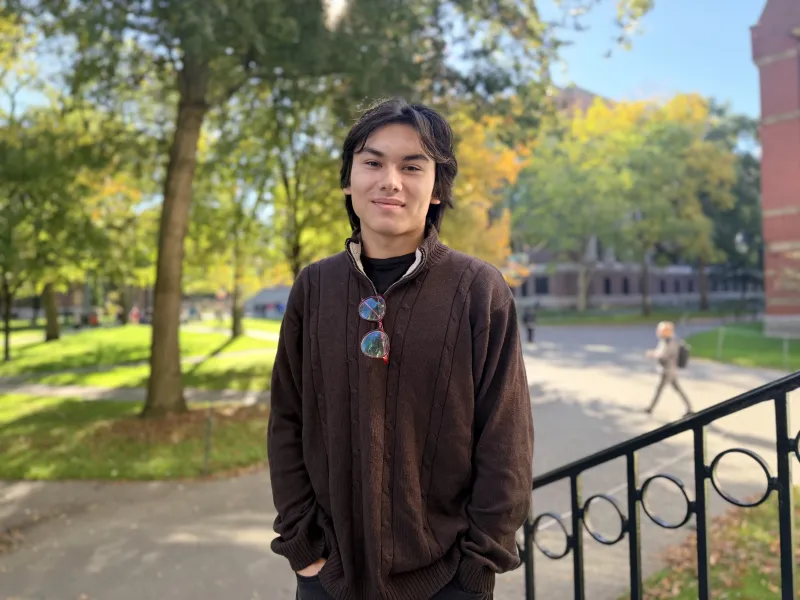
Jonathan Wescott '28. Photo provided by the Harvard College Dean of Students Office.
Looking ahead, Yassin hopes the board will continue to be a place where students can bring the “full texture” of their experiences. “I’m also a first-generation and low-income [student], so whether that’s navigating being one of only a few in a space, I want students to know that when they carry the full texture of their stories into programming, the work becomes more generous and honest, and the campus feels more connected.”