
Senior Creates Caregiving Cultivation App
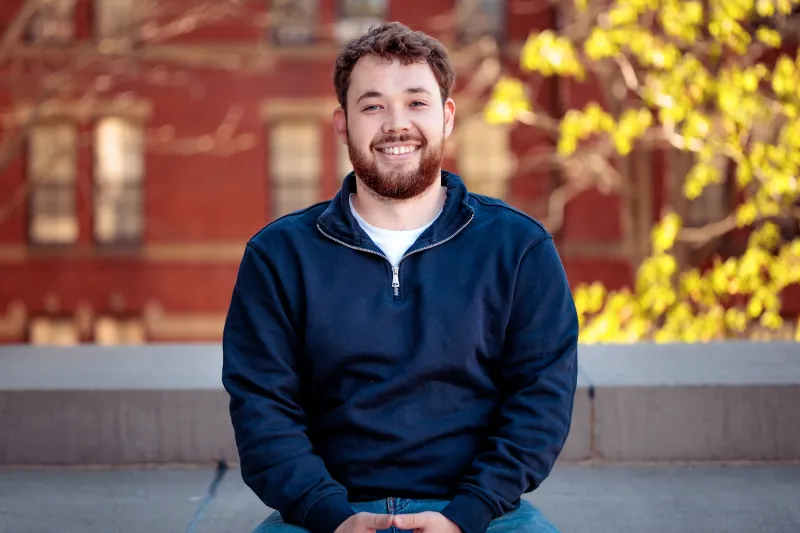
Community is key to Kai Wong ’26.
Growing up in Japan and Australia, Wong discovered that exposure to deep connections and diverse communities proved essential for holistic well-being.
At Harvard College, Wong relished the opportunity to expand their network, and in the flexibility of a liberal arts education. “That [experimentation] was big for me in finding what my interests were and having the space to pursue them in the way I wanted,” they said. “I knew I wanted to be involved in healthcare and community work, which is why I went into a special concentration.”
Wong credits their Innovation and Social Impact concentration to the Strategies for Social Impact course taught by Matthew Lee, Associate Professor of Public Policy and Management at Harvard Kennedy School. “It was a very cool environment to be in, and there were a lot of really interesting discussions,” they said. “The material was very case-study oriented, so it felt very connected to real-world application and helped me gain perspective.”
With support from the Amara Balthrop-Lewis Endowed Fund for Special Concentrations (ABLE Fund) and a geriatrician at Harvard Medical School, Dr. Masaya Higuchi, Wong spent the summer before senior year in Shiroishi City in Miyagi Prefecture, Japan, doing fieldwork with an elderly homecare company. “There are a lot of things that you can research beforehand,” they said, “but the fieldwork was important in day-to-day realities.”
Wong met families and patients, spoke with care managers, and connected with a social welfare council. During this work, Wong was surprised to see that homecare visits, meant for a medical concern, spent just as much time, if not more, on social interaction. “It really showed that the social aspect of care is so important,” they said.
“Early on, you don’t want to go in and impose your own perspectives, assume the correct solution, or ways of doing something, but instead let the needs emerge naturally from the stakeholders.”
Combining their other experiences of studying abroad in Argentina, India, and South Africa researching gendered differences in aging, personal difficulties in finding care for their grandmother in Japan, and knowledge of worldwide caregiver shortages, patterns linking loneliness and health outcomes began to emerge.
To address these concerns, Wong came up with the idea to develop a community care-matching app to connect elderly people with companion-based caregivers in their neighborhoods. Advised by Professor Lee and Roland Fryer, Professor of Economics at Harvard University, this idea then turned into Wong’s senior capstone project.
Wong enlisted the help of Harvard’s Tech For Social Good to develop the app’s software. Each week, they collaborate with Wong to discuss platform updates and next steps. “The goal is to rebuild community members and sense of community,” Wong said. “That’s been declining in Japan, and current volunteer programs aren’t doing great, so if we can contribute and help rebuild relationships within neighborhoods, I think that’s our biggest goal.”
The Mayor of Shiroishi, Yuuichi Yamada, is also a supporter of the project, and told Wong to email him with anything needed to push it forward. “He was very excited that if this succeeds,” Wong said, “they can say this project came out of Shiroishi, and hopefully try to scale it to other places.”
Ultimately hoping to launch at the end of 2026, the app now has a name: Gokinjo Care — “Neighborhood Care” in Japanese.
“We’ll have to see, but it’s very exciting to see where it might go,” Wong said.