
Winthrop Installation Connects Past, Present and Future
New mini exhibition brings awareness, context after review.
This past summer a committee review recommended that John Winthrop House maintain the “Winthrop” name but remove the given name “John.” A new pop-up installation in the house lobby aims to put that decision in a clearer context.
“What’s In A Name? Confronting the Past in the Present At Harvard & Winthrop House” invites students to interact with house history through four panels of text, imagery, and an interactive QR code system. Brenda Tindal, chief campus curator in the Faculty of Arts and Sciences and a member of the Winthrop denaming review committee, explained the installation: one panel shares Harvard’s principles behind renaming while another amplifies the work of the students who drafted the original request for the committee’s consideration. The final panel spotlights the work of the review committee and outlines the recommendation to formally change the house name to Winthrop House.
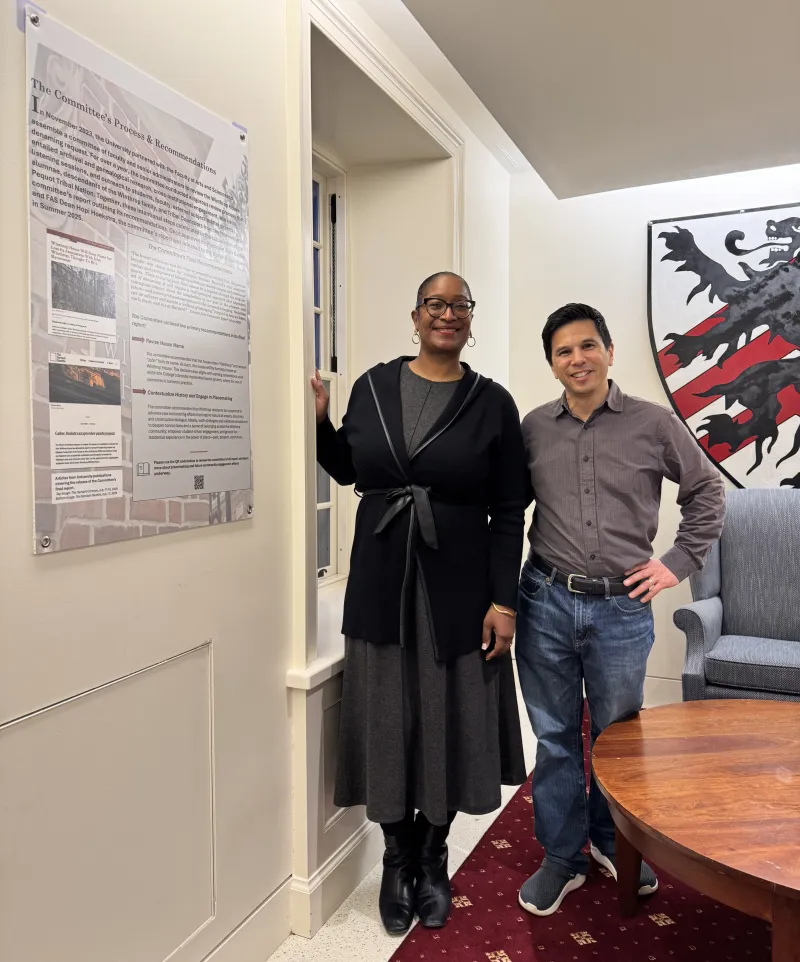
“Our hope is that it will present new opportunities to understand the University’s tenets for renaming, the thoughtful advocacy of our students, and the committee’s rigorous review as we embark upon the work ahead,” said Tindal, adding that this kind of placemaking is important not only for scholars interested in the history of Winthrop, but also for those with general curiosity about “the process we undertook as a community.”
The spirit of openness and accessibility reflected in the panel exhibition mirrors the process the committee used to ground their work, Tindal said. The committee conducted interviews and conversations with a range of stakeholders including students involved in the original denaming petition, faculty, Winthrop House students, community members, members of the Native American community, and descendants from the Winthrop families.
The committee worked to reconcile the troubling actions of John Winthrop, a professor at Harvard College who served as acting President and was likely to have owned two slaves. Along with Winthrop House leadership, Tindal’s placemaking effort is a multiyear process guided by efforts that center belonging, learning, ethical stewardship, and community. The installation will stay up through the spring semester.
Winthrop House Faculty Deans Kiran Gajwani and Stephen Chong see the installation as a way to help facilitate conversations.
“We’ve seen our role throughout this whole process largely as supporting the community,” Chong said.
“Our priority is this being a community effort, where students are central to the process,” added Gajwani.
Under their leadership, Winthrop House created the Winthrop Contextualization and Placemaking Leadership Team, composed of resident scholars, resident tutors, the faculty deans, Tindal as well as two Winthrop students. The Winthrop Contextualization and Placemaking Leadership Team is focused on implementing the recommendations of the committee's report, with immediate attention towards learning about Winthrop’s history and starting community engagement. A new “Winthrop House” plaque is scheduled to replace the “John Winthrop House” plaque this spring.
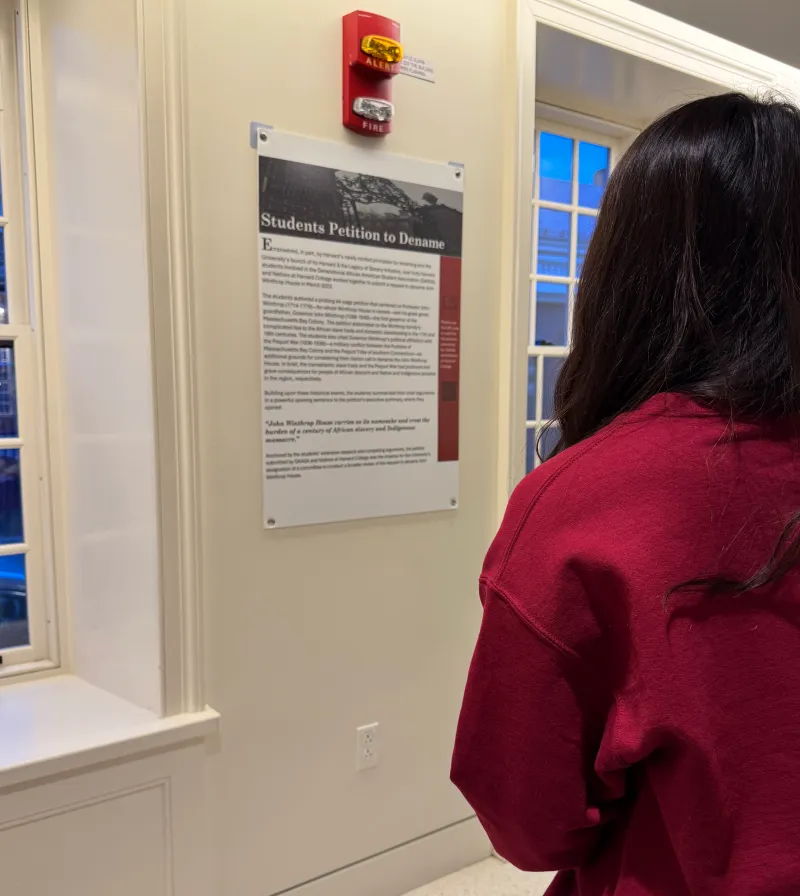
“For me, it was something I wanted to take in for my own understanding… this is an opportunity for me to learn about so many convoluted topics at the foremost institution which sets the norms for all other educational institutions, around the country and world,” Ishan Tiwari ‘26, a Winthrop resident and student on the leadership committee, said.
Tindal, who also serves as executive director of the Faculty of Arts and Sciences Office for Academic Culture and Community, emphasized the importance of working alongside the entire Harvard community. “Opportunities to be in thought partnership with students, faculty, and staff as we work to inspire deeper connections, to me, is at the heart of the academic enterprise,” Tindal said.
Moving forward, the Winthrop work has yielded a sense of optimism for House leadership. Said Chong: “The engagement of the community in making Winthrop a place we want to be home, there’s so many exciting possibilities in this process.”