
Building Community Through Accountability: Restorative Practice Fellows
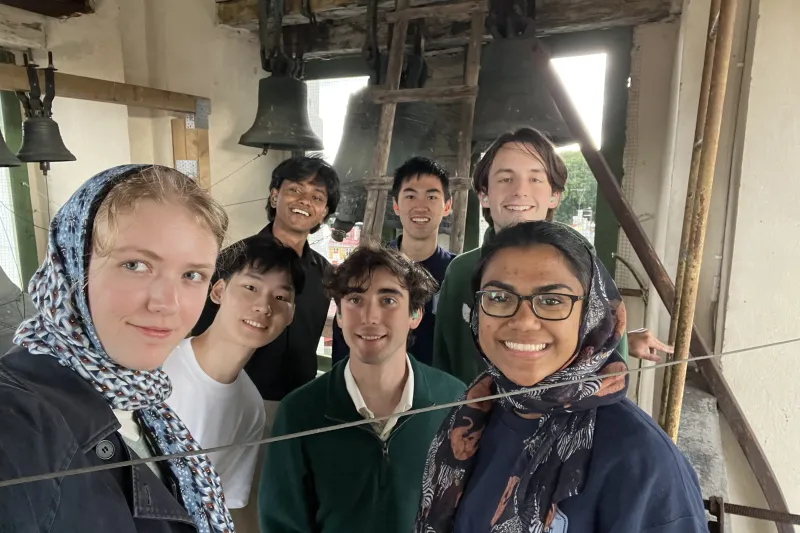
In the spring of 2023, the Office of Student Services (OSS) hired four undergraduates: Paige Breyer ’27, Nayan Sapers ’26, Laiba Khan ’25, and Elyse Martin-Smith ’25, to build and run a new initiative called the Restorative Practice Fellows (RPFs).
Disclaimer: The Office of Student Services was restructured in mid-2026 after this article was published. The program still operates under the SOC.
The premise was straightforward: conflict is inevitable in any community, and what matters is how that community chooses to respond to it. Restorative practices draw from traditions rooted in Indigenous and Native American communities and have been implemented throughout various contexts, including education, criminal justice, and medical communities. They prioritize relationship-building, open dialogue, and collective accountability over historically punitive responses to harm; the orienting questions shift from “what rule was broken?” to who was affected, what they need, and how the community can move forward together.
After extensive research into programs at peer institutions, the RPFs adopted a student-run model that is housed within OSS and receives administrative support from Harvard College. Titus Adeleke, Assistant Dean and Secretary of the Administrative Board in the Office of Academic Integrity and Student Conduct (OAISC), and Lindsey Ciolfi, Assistant Director of College Title IX, provide ongoing supervision, guidance, and logistical coordination.
The RPF program's mission statement frames the work as an effort “to create supportive, accessible spaces where members of the Harvard College community can navigate conflict, strengthen communication, and repair harm through restorative practices,” with the stated goal of building more connected communities.
The program’s work is distributed among three pillars: community building and education, through which RPFs develop modules for student groups seeking to learn about restorative practices; facilitation of educational programs connected to Administrative Board actions; and responses to community concerns.
Beyond these goals, RPFs hold weekly office hours open to any College student or community member, whether they are navigating a personal conflict, looking for guidance on how to bring restorative practices into their organization, or simply trying to figure out what options are available to them. Office hours, scheduling, a contact form, and more information about the program are all accessible through the program's website.
Privacy is an important tenant of the program’s work; however, RPFs are not confidential resources. RPFs are designated as responsible employees at the University. As responsible employees, RPFs are required to report instances of sexual harassment and other sexual misconduct, including harassment based on gender and sexual orientation, that impact a Harvard community member to a Title IX Resource Coordinator.
To start the 2025-2026 academic year, RPFs welcomed Kiley Wilhelm ’28, Zain Memon ’28, Winifred Ofori-Manu ’27, and Jamie Durant ’26. Those involved describe a close-knit group united by a shared purpose.
“My experience as a student at Harvard has taught me the value of community, and I joined the RPFs because I wanted to contribute to a space that has given me so much,” Wilhelm said.
“As a student-athlete, I know the importance of resolving conflict and working with my peers to achieve a higher goal, and I carry that into my conversations with students. In our work, we value empathy and understanding within conversations.”
“Being an RPF is a great opportunity to help students connect across differences and help cultivate a healthier campus community,” Memon agreed. “I have loved getting to work with students, learning about their lived experiences and working towards ways to repair relational harm and take accountability.”
Ofori-Manu added that the work offers a “clearer understanding of how the College's administrative processes actually operate. It has been rewarding to support students through conflict and to see them leave the process feeling heard, more grounded in their understanding of what happened, and better prepared to move forward in a way that reflects restorative approaches.”
RPFs hope to establish precedent, not only for Harvard's graduate and professional schools, but for other institutions nationally, for how student-driven restorative work can reshape campus life.
Student groups and organizations interested in a community-building presentation can reach out to rpf@fas.harvard.edu.
Students interested in becoming RPFs can contact Titus Adeleke and now complete an application for the 2026-27 academic year with a priority deadline of April 20, 2026.