
First-Year Seminar Program launches post-seminar experiences
When the Fall 2025 semester ended, learning in First-Year Seminars did not.
Instead, students in four seminars returned in January 2026 for fully-funded immersive experiences that extended their academic work beyond the term. Some stood on the deck of a whale-watching boat off the Massachusetts coast. Others explored the pyramids of Teotihuacan in Mexico. Another group presented an experimental water-quality sensing buoy to scientists at the Woods Hole Oceanographic Institution. On campus, participants began building research skills alongside faculty in the Department of Earth and Planetary Sciences, supported by a $2,000 stipend.
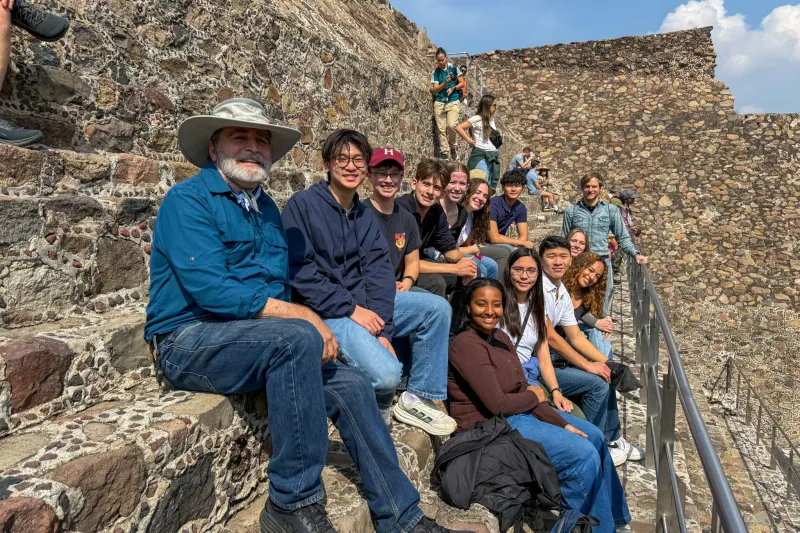
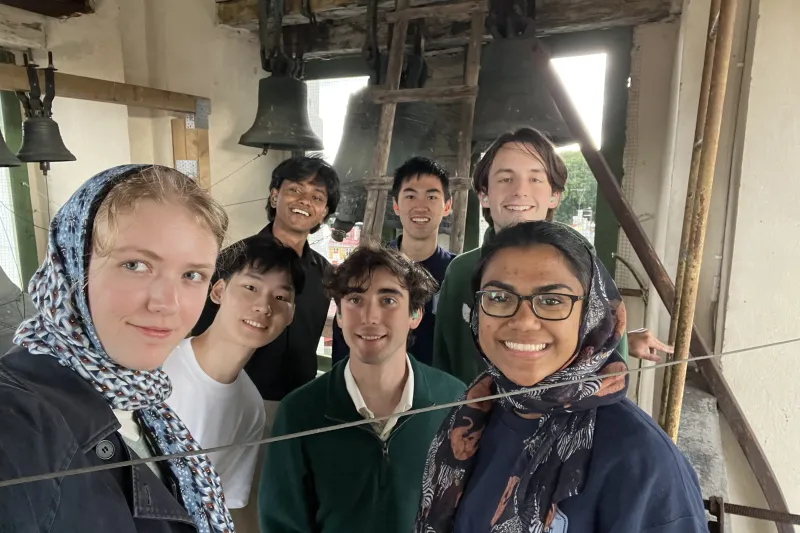
Professor Bill Fash, lecturer Jennifer Carballo, graduate student Luke Hollis and first-year students at the Pyramid of the Sun in Teotihuacan, Mexico.
These post-seminar experiences were newly made available this year by the First-Year Seminar Program (FYSP). Designed by seminar faculty and coordinated by FYSP, the experiences aim to provide unique opportunities for first-year students to deepen their seminar experiences in real-world environments.
In “A Whale Ship Was My Yale College and My Harvard”, James Duncan Phillips Professor of Early American History, Joyce Chaplin, spent the fall semester guiding first-years through Herman Melville’s Moby Dick. Reading about the characters’ experiences on land and at sea, she suggested, is not the same as encountering the maritime world that shaped the text.
“To read the novel indoors–far from the shoreline–seems wrong!” Chaplin said.
For the course’s post-seminar experience, Chaplin brought students into the New England maritime world where Melville’s story begins. They went whale watching, visited the New Bedford Whaling Museum, and Nantucket. Earlier in the semester, they toured the USS Constitution in Boston.
“Now, I hope when the students think of Queequeg ‘sauntering’ through Nantucket with his harpoon, or of Ishmael listening to a sermon on Jonah at the Seamen’s Bethel in New Bedford,they have an even more vivid sense of what that might have been like, because they’ve been in those places,” she said.
In “Lasers in the Maya Jungle: Discovering Lost Cities in Mexico and Central America,” Bowditch Professor of Central American and Mexican Archaeology and Ethnology, William Fash, introduced students to Light Detection and Ranging (LiDAR) technology, which has recently been used for discovering, mapping, and dating archeological features and sites. Over the course of the fall semester, students examined digital imagery produced by LiDAR that revealed vast ceremonial centers and urban networks previously obscured by forest canopies. In January, that conceptual work gave way to field work as part of the post-seminar experience. Under the guidance of Fash, first-years visited major sites around Mexico City, Mexico, including Teotihuacan, El Templo Mayor of Aztec Tenochtitlan, preclassic ruins of Cuicuilco, along with other excavation areas and museums.
“It is one thing to look at LiDAR images and maps in a classroom and entirely another to experience the scale and spatial logic of an ancient city in person,” Fash shared. “Travel allowed students to engage directly with people and places we discussed in the Seminar, underscoring the complexities of international research and collaboration.”
While Fash’s seminar illuminated ancient urban worlds, Nathan Melenbrink’s First-Year Seminar turned students toward present and future environmental challenges. Students spent the fall semester exploring the critical need for affordable, long-term water quality monitoring devices in "Machine Ecology: Autonomous Robots for Environmental Restoration”. They engaged in “open-ended prototyping, testing unconventional materials and methods, and learning through iteration”. This learning process culminated with a post-seminar experience at the Woods Hole Oceanographic Institution in Woods Hole, Massachusetts, where students presented a collaboratively designed, instrumented buoy to working scientists and engineers.
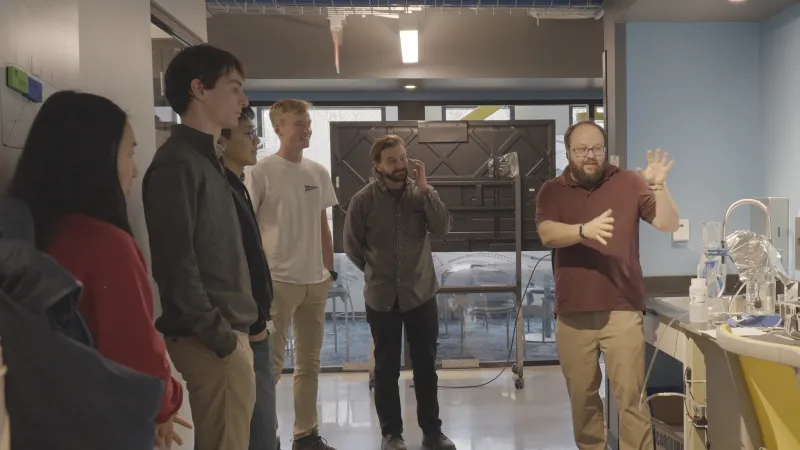
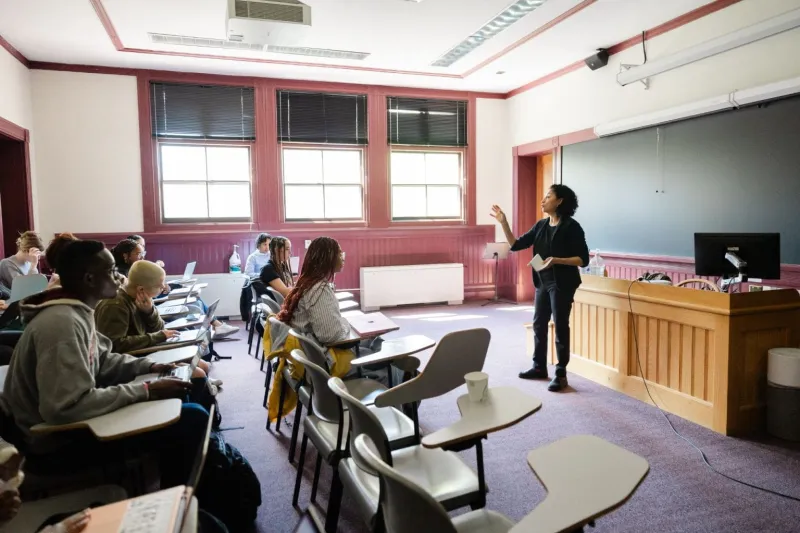
Students learning in the classroom.
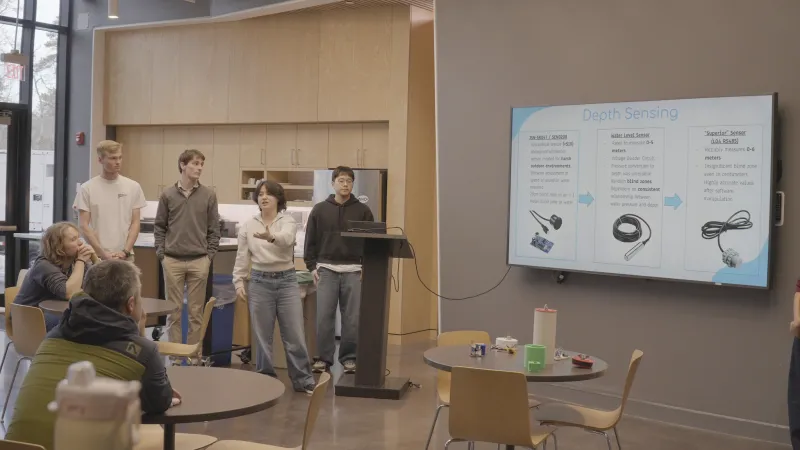
Students learning about depth sensing.
"By situating students within WHOI’s active research community, they were able to see how sophisticated instrumentation, field deployment, and even citizen science initiatives operate at professional scale,” Melenbrink said of the experience. “Presenting their prototype to working scientists and engineers transformed the project from a classroom exercise into a real-world design conversation. The experience also opened doors to potential internships and mentorship, while giving students a clearer view of what climate and ocean-focused careers can look like in practice.”
Similiar to Machine Ecology, “Earth Science Goes to the Movies: Math and Physics of Natural Disasters,” taught by Professor of Earth and Planetary Sciences, Miaki Ishii, used the post-seminar experience to move first-years from theory to early research practice. After spending the fall semester analyzing the physics behind movie depictions of natural disasters, students returned to campus in January to participate in research activities for the Department of Earth and Planetary Sciences (EPS).
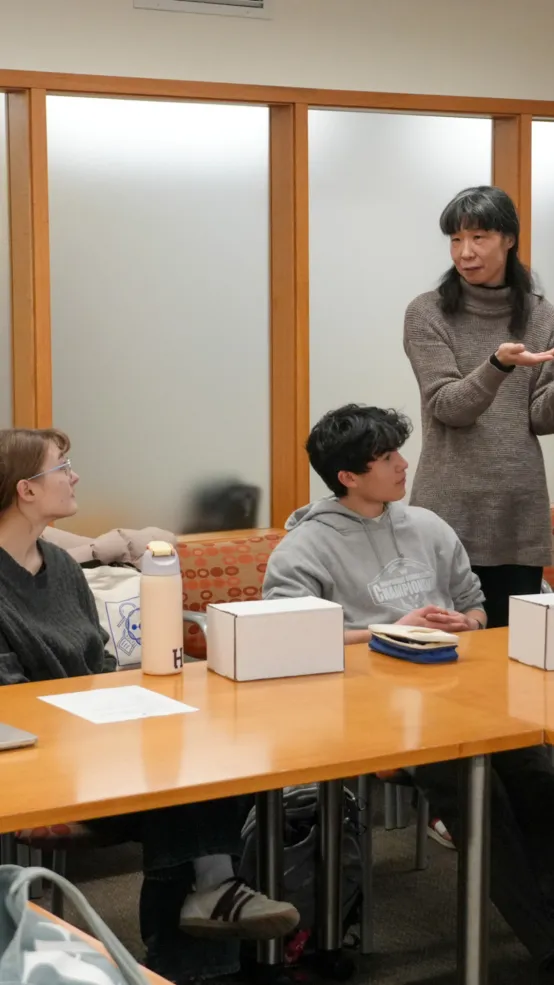
Professor Ishii used the post-seminar experience to move first-years from theory to early research practice.
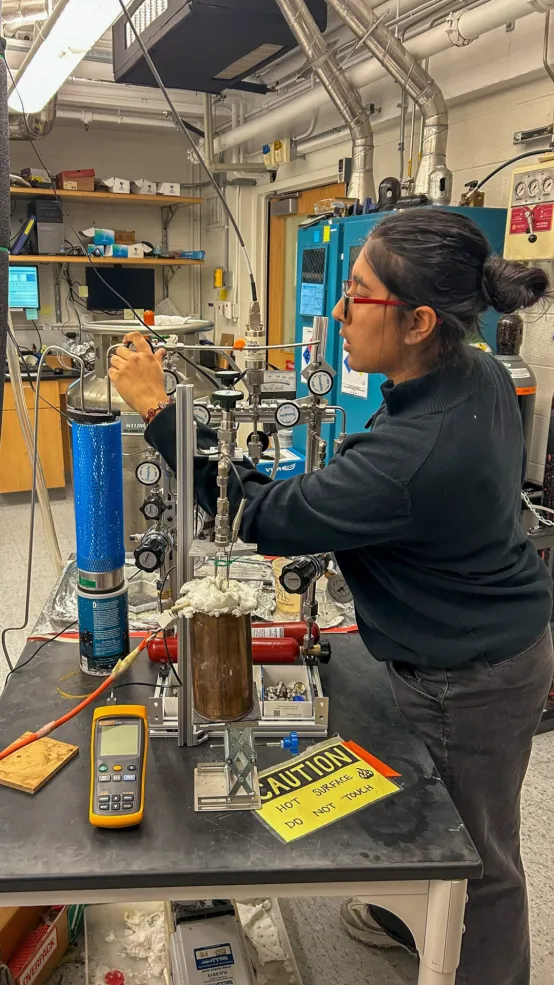
Students applied their research skills in the lab.
“For us, the [post-seminar experience] worked quite well in getting students engaged in research and deepening their understanding of what research is about,” Ishii said. Over the course of two weeks, students were exposed to different areas of the discipline through skill-building workshops and assigned to research “hosts” within EPS.
"It was an amazing opportunity that most students don't have, especially in their first semester,” one student wrote in an anonymous seminar reflection. “The J-Term is an extremely rewarding part of this class,” wrote another. “You are not only exposed to a wonderful opportunity to work on research, which is a critical part of being a scientist, but are guided, mentored, and well-supported throughout the process. [I] wouldn't have traded this experience for the world."