Video description:
up close of students in the classroom, and then it pans to a female professor reading from a book to the class, students in the auditorium in a large class then it pans to the back of a male professor teaching in the front of the class,
Concentrations
Overview
What are Concentrations?
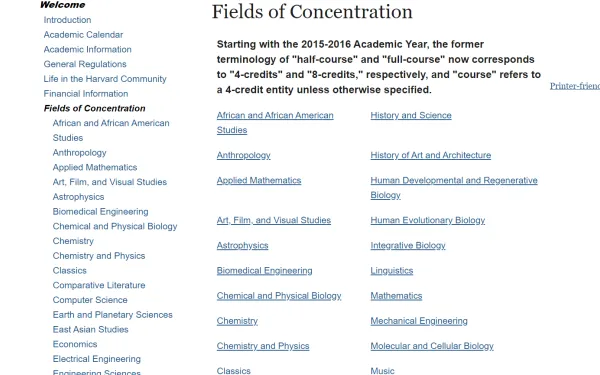
At Harvard College, students choose a "concentration," which is what we call a major. You also have the opportunity to choose a secondary concentration as a minor or pursue a special concentration where you can design your own course of study. With more than 3,700 courses in 50 undergraduate fields of study, you'll have plenty of chances to find your passion.
Bachelor of Art = B.A. Bachelor of Science = B.S.
-
Social Sciences
Economics is a social science that covers broad subject matter in seeking to understand the social world. An economic analysis begins from the premise that individuals have goals and that they pursue those goals as best they can. Economics studies the behavior of social systems—such as markets, corporations, legislatures, and families—as the outcome of interactions through institutions between goal-directed individuals. Ultimately, economists make recommendations that they believe will make people better off.
Learning Objectives
The Harvard Economics Department aims to teach undergraduate students the basic principles of economics, to introduce them to various subfields within economics, and to give them a foundation in understanding and carrying out economics research.
Gateway Courses
- ECON 10a (fall, spring) and 10b (fall, spring), Principles of Economics. Open to all students, no pre-requisites. Students interested in economics are encouraged to take Ec 10 during freshman year. (Students with appropriate AP or IB scores in economics may skip the relevant semester of Ec 10ab, but each skipped semester of Ec 10 must be replaced with an economics elective. See website or an ec advisor for details.)
- MATH 1a (or equivalent) (fall). Required of all concentrators and necessary for the Econ 1010/1011 courses and many higher level ec electives. (Students who placed out of Math 1a on the Harvard math placement test or who earned a 5 on AP Calculus AB or BC are deemed to have fulfilled this requirement.)
- One of STAT 100, STAT 104, STAT 109, STAT 110, AM 101, MATH 154 or ECON 20. (spring) Concentrators need a basic understanding of statistics before proceeding into the Econ 970 Sophomore Tutorial and Econ 1123/1126 econometrics courses.
- ECON 1010a (fall, spring) or ECON 1011a (fall), Intermediate Microeconomics. Introduces students to higher-level microeconomic theory, preparing them for more advanced ec electives and applications of economics.
- ECON 1010b (fall, spring) or ECON 1011b (spring), Intermediate Macroeconomics. Introduces students to higher-level macroeconomic theory, preparing them for more advanced ec electives and applications of economics.
- ECON 1123 (fall, spring) or ECON 1126 (varies), Econometrics. Gives students the necessary tools to understand and undertake empirical economics research.
- ECON 970 (fall, spring), Sophomore Tutorial (can be taken as a junior). A transformative course for ec concentrators! Students learn how to apply key economic principles to a particular field of economics and learn how to read, critique, and carryout economics research.
- ECON 50, Using Big Data to Solve Social Problems. Gives students an introduction to frontier research in applied economics and social science that does not require prior coursework in Economics.
-
Social Sciences
The Department of Government—like political science—is an umbrella for a remarkable range of political subjects and approaches to studying them. It stands at the cross-roads of history, law, economics, sociology, philosophy, and ethics, borrowing from these disciplines as well as constructing theories and methods of its own.
Learning Objectives
Our first goal is to make all students aware and critical of their unexamined assumptions about politics. Learning to think independently and with some critical distance, to analyze arguments—theoretical, empirical and rhetorical—to weigh alternatives, to write cogently, and to speak persuasively are essential skills for responsible global citizenship as well as professional careers. To achieve breadth in the discipline of political science is our second aim. Third, we encourage students to chart a distinctive path through political science. We offer each student the possibility of satisfying his or her particular intellectual bent and curiosity through a cluster of electives and at least one required seminar. Finally, we encourage students to produce as well as consume political science research.
Gateway Courses
- GOV 10: Foundations of Political Theory
- GOV 20: Foundations of Comparative Politics
- GOV 30: American Government: A New Perspective
- GOV 40: International Conflict and Cooperation
- GOV 1005: Data
-
Social Sciences
Psychology is the scientific study of the mind, and as such, we investigate the minds of humans and other species. We try to understand the mind at many different levels of analysis, from taking measurements from the brain, through learning about the individual, all the way to understanding groups and organizations. Most of the research conducted in Harvard’s Department of Psychology concerns basic psychological processes such as attention, perception, memory, categorization, reasoning, decision-making, language, cognitive and social development, social cognition, intergroup relations, and morality. In addition, some members of the department conduct research on the etiology, development, and treatment of psychopathology. All members of the department share the common goal of understanding mind, brain, and behavior through empirical investigation, and their teaching and research reflect this goal.
Learning Objectives
The primary goal of the Psychology concentration is to provide students with a fundamental understanding of the human mind. In the process of doing so, other goals will also be achieved: the skill to critically assess quantitative evidence from experimental and correlational data, to learn to take difficult and previously unstudied problems of mind and society and bring them under experimental scrutiny, to learn to speak and write about questions of great theoretical and social importance that involve the mind.
Gateway Courses
Psychology requires course completion in the following order:
First, take:
- PSY 1: Introduction to Psychological Science (formerly SLS 20, offered fall and spring) is a prerequisite for the majority of psychology courses and required for the concentration or secondary field. You may be able to count a Psychology AP score of 5 or IB score of 7 towards the Introductory course requirement. Please contact the Psychology Undergraduate Office at psychology@wjh.harvard.edu to learn more.
- PSY 1900: Introduction to Statistics for the Behavioral Sciences (offered fall and spring) is required by the end of sophomore year. It can be taken prior to or concurrently with PSY 1.
Then, take two of the following Foundational Courses (see track-specific requirements).
- Psychology 11: Cognition: How the Mind Works
- Psychology 14: Cognitive Neuroscience
- Psychology 15: Social Psychology
- Psychology 16: Developmental Psychology
- Psychology 18: Psychopathology
-
Social Sciences
Sociology is the study of society, of the social frameworks within which we live our lives. It is a study of social life at every level, from two-person relationships to the rise and fall of nations and civilizations.
Sociology is excellent training for careers in law and public administration, medicine and public health, advertising and marketing, politics and public policy, business, banking, and consulting.
Learning Objectives
We prepare students to develop sociological questions and to design and conduct systematic and rigorous research. Hands-on experiences are integrated into sociology electives, advanced methods courses, senior theses, and faculty RA opportunities. Because studying social processes requires a broad range of approaches, we offer instruction in statistical modeling, in-depth interviewing, ethnographic observations, archival investigations, and computational analyses. Concentrators select from a range of topical and methodological electives. Those interested in emphasizing methodological training can select the Data Analytics track.
Gateway Courses
These courses are designed to give you an introduction to the discipline:
- SOCIOL 1000: Introduction to Sociology
- SOCIOL 1024: Social Inequality
- SOCIOL 1023: Political Sociology
- SOCIOL 1046: Life and Death by Design (not offered 2024-2025)
- SOCIOL 1058: Sex, Gender, and Sexuality
These Gen Ed courses also introduce you to a sociological approach and count as a sociology concentration elective:
- Gen Ed 1019: The Caribbean Crucible
- Gen Ed 1092: American Society and Public Policy
- Gen Ed 1115: Human Trafficking, Slavery and Abolition in the Modern World
- Gen Ed 1192: Philanthropy, Nonprofits, and the Social Good
Many students discover Sociology by starting with an elective course. You can take any 1100-level or 1200-level course on a topic that interests you. Find our offerings here: https://sociology.fas.harvard.edu/pages/courses
If you have confidence that you are going to concentrate in sociology you might consider taking one of the following core courses that are required for concentrators.
- SOCIOL 97: Social Theory (offered fall and spring)
- SOCIOL 1128: Models of Social Science Research (offered spring only)