
Creating community in uniform and university
Standing at her twin sister’s Marine Corps boot camp graduation, Vanessa Valverde ‘27 felt herself glow with pride. She had always looked up to her sister, yet seeing her in uniform with a newfound sense of discipline and composure was inspiring in a different way.
Though Valverde was attending college at the time, she wasn’t sure what she wanted from it. Watching this graduation planted a seed—if her sister found a sense of purpose in military service, perhaps she would, too.
Valverde left college after her first year at the University of California, Riverside and enlisted in the Marine Corps, where she spent six years as a signals intelligence analyst—an experience that shaped her ambitions, closest friendships, and understanding of service.
As a signals intelligence analyst, Valverde helped provide indications and warnings to the units she supported, building situational awareness for military decision-makers. Much of her early work involved ground combat elements, including infantry and artillery units. Working alongside people with different responsibilities taught her to identify and match the needs of her target audience, and gave her an appreciation for the technology and people behind military operations. Ultimately, she learned the importance of getting things right the first time, especially when others depended on her work.
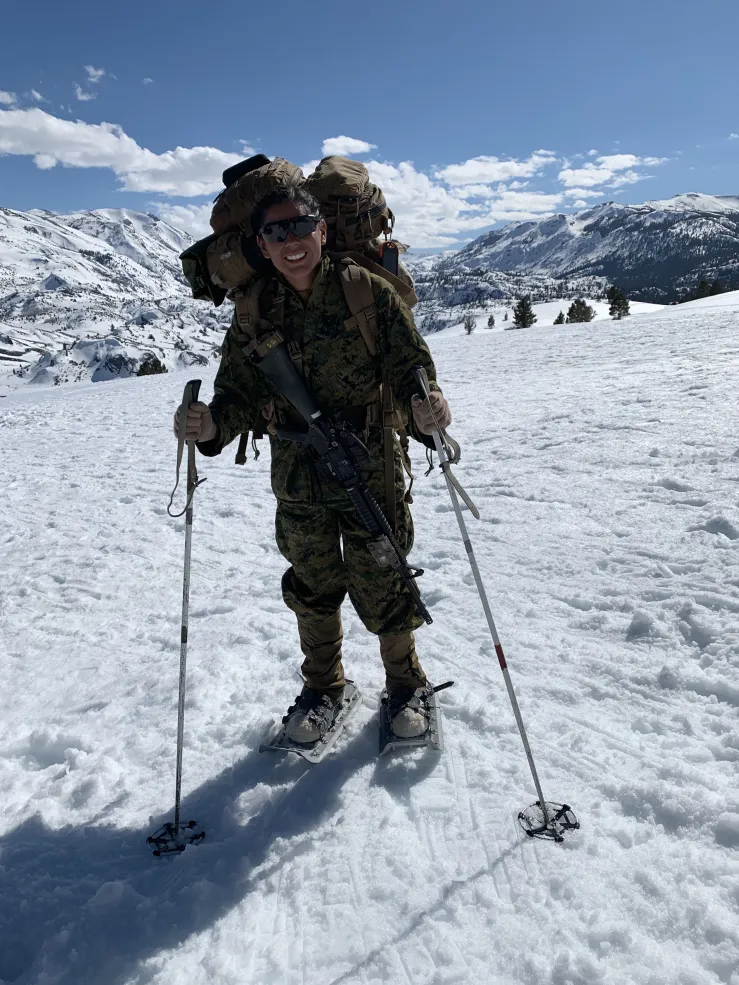
One of Valverde’s earliest formative experiences in the Marine Corps took place in Bridgeport, California, during cold-weather combat training. Having barely encountered snow before, she found herself buried under roughly twenty feet of it, sleeping in cramped tents, having to boil her own water, and digging snow holes for shelter. Though the conditions were less than desirable, the memories created there remain some of her fondest.
She remembers the absurdity of being exhausted, cold, and uncomfortable alongside her fellow Marines. Yet in those moments, she recalls times when the group would laugh hysterically, finding humor in the most tenuous of circumstances. “It was the best first experience, because not only was I super uncomfortable, but I got to experience that with people who eventually I spent the next six years with,” she said. “Those end up being your best friends.”
She navigated demanding training, difficult assignments, and deployments abroad, including to Japan, Australia, and the Philippines, with her fellow Marines. At one point, Valverde imagined staying in the military for the full twenty years. She had found her people, her work, and a sense of purpose she had once struggled to identify.
Valverde’s decision to leave the Marine Corps wasn’t easy. One year before her service term was set to end, she decided to re-enlist for an additional two years, feeling she had more to offer and accomplish.
Embracing the journey
Valverde in 2018, participating in Cold Weather Training in Bridgeport, California.
Serving with a smile
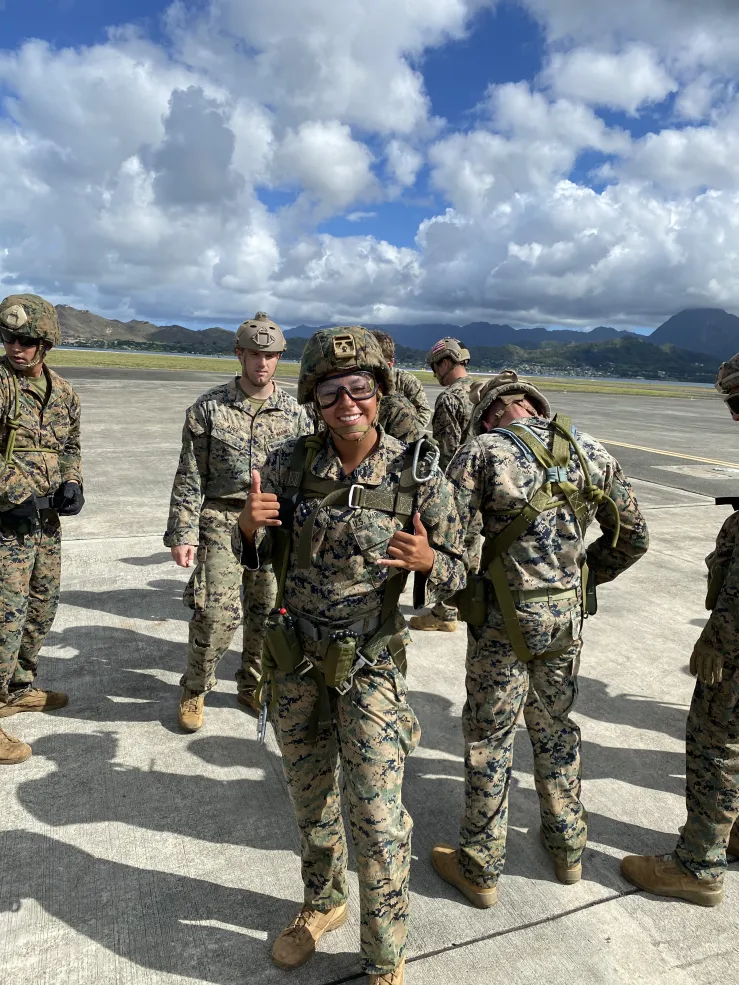
Valverde in 2020, participating in SPIE (Special Purpose Insertion/Extraction) Rigging.
When her last re-enlistment was on the horizon, she began considering other possibilities.
College alone did not seem like a sufficient reason to leave behind the life she built. She wanted her next step to have a broader impact on the institution and community that had given her so much. “I had thought to myself, if I’m going to leave the Marine Corps, it has to be for something that feels bigger than it,” she said. “Right now, the Marine Corps is my world.”
During her time serving on active duty, Valverde enrolled into the Warrior-Scholar Project, which helped her prepare for the academic demands of college and navigate the application process. Through the program, she began to see an Ivy League education as a realistic path forward.
“Harvard is an option for me,” she recalled thinking at the time. “I think I could actually fit in here.”
Valverde credits the leaders who guided her throughout her military career with helping her reach that point. She describes herself as fortunate to have landed in a role and unit that gave her opportunities to learn, with commanders who encouraged her to pursue leadership opportunities, recognized her accomplishments, and gave her the space to explore her future.
“I wouldn't have been in this position if my command didn’t choose to put me in positions to help me grow as a person, a leader, and as a Marine,” she said.
That sense of collective responsibility shapes how Valverde thinks about Veterans Day. For her, the holiday is not solely an opportunity to recognize military service, but it’s also a reminder of all the people whose sacrifices and contributions make other’s dreams possible. She makes a point of reaching out to the people who helped her along the way, whether sending a text or making a phone call to remind them that she is thinking of them.
“Now that I’m here on this campus,” she said, “it really emphasizes that there's so many people who helped pave the way for me to be here.”
On November 11, 2026, the Harvard Foundation will host a Veterans Day observance at Memorial Church, open to all members of the Harvard College community and general public. The event will recognize the service and sacrifices of veterans and service members while creating space for the broader Harvard community to learn from and honor their experiences.
As a Harvard College senior concentrating in government with a focus on national security and defense technology, Valverde’s academic interests have been shaped by her experiences in the Marine Corps.
Having seen equipment fail in the field, she is interested in how closer relationships between those who develop technology and those who use it might improve the process. She hopes to better understand and influence how defense technology is developed, procured, and delivered to the people who rely on it.
She also hopes to use her senior thesis to investigate an issue more dear to her heart—mental health among Marines and veterans, including those who have not experienced combat. Having encountered mental health struggles among young service members early in her own career, she wants to explore how people navigate the loss of an identity built around combat.
Her own transition to undergraduate life was not seamless. Not until after Valverde moved away from her family-like friends in the Marine Corps and onto the Harvard campus did she realize the importance of their shared identity. Despite making new friends and being welcomed at Harvard, she found herself missing the Marine Corps, especially as the Marine Corps Birthday and Veterans Day approached. In her role as president of Harvard Undergraduate Veterans Organization (HUVO), she hopes to give back to the community that built her up by making the adjustment for other veterans easier.
As part of the Office of Culture and Community within the Dean of Students Office, the Harvard Foundation supports military veterans studying at Harvard through inclusive programming, engaging events, and opportunities for meaningful connection.
Through HUVO, Valverde organizes events that bring students and their families together. Seeing her fellow veterans gather, introduce their loved ones, and spend time together is incredibly rewarding for her. Valverde also strives to help veterans navigate the practical challenges of Harvard, from finding internships and preparing resumes, to meeting fellow students and identifying resources on campus.
“I’m hoping through my trials and tribulations, I can help the other generations of veteran undergraduates here on campus,” she said.
For veterans arriving at Harvard, Valverde’s key piece of advice is a phrase not often heard in the Marine Corps—to give yourself grace.
As the military often emphasizes mission, discipline, and structure, leaving that environment can mean losing the clearly-defined purpose that once organized nearly every aspect of veterans’ daily lives. For veterans, learning to navigate the freedom found within Harvard’s unlimited possibilities can take time.
Valverde encourages fellow veterans to not compare their transition with anyone else’s. Instead, she urges them to allow themselves to try new things, make mistakes, and discover interests they may not have known existed.
“Here's the place to be successful, whatever you're passionate about,” she said. “Don’t put yourself in a box; try and test all of your passions that you have.”