
Students Explore the Future of Learning at Generative AI Summit
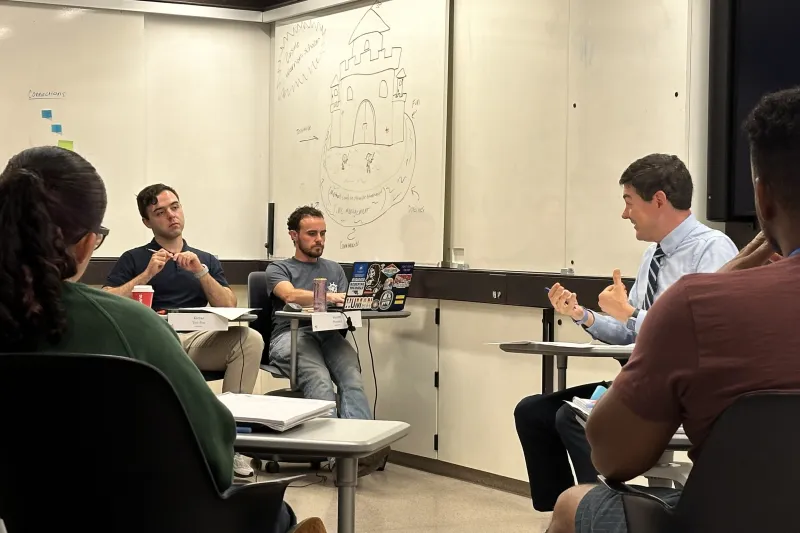
On January 31, Harvard College students gathered in the Thompson Room of the Barker Center for the Student Generative AI Summit, a two-hour working session focused on shaping the College’s approach to artificial intelligence in the classroom.
The summit, sponsored by the Office of Undergraduate Education, began with opening remarks from Danoff Dean of Harvard College David Deming, who invited students to develop recommendations to share with College leadership. The discussion was guided by a central question: how can a liberal arts education evolve in an era of increasingly present AI tools?
Students organized the discourse around three central areas that reflect the most immediate institutional challenges posed by generative AI: Academic Integrity and Student Use Policies, Instructional Use Cases, and College-Wide Learning Objectives. Each group examined a different dimension of AI’s role at the College.
The Academic Integrity group discussed how existing policies apply to AI-assisted work and explored the importance of transparency and clear expectations across disciplines. Participants considered how faculty can distinguish between appropriate tool use and work that substitutes for learning.
In the Instructional Use Cases group, students examined ways AI might support classroom engagement, including personalized tutoring tools, feedback systems, and coding assistants. Several participants emphasized the importance of ensuring that students develop foundational skills alongside AI literacy.
The third group, College-Wide Learning Objectives, focused on whether Harvard should articulate shared competencies related to AI. Students noted the value of teaching all undergraduates how to evaluate AI-generated content, understand its limitations, and use it responsibly across fields of study.
After small-group discussions, students reconvened to refine their recommendations and present them to administrators, including Dean of Undergraduate Education Amanda Claybaugh and other members of the Faculty of the Arts and Sciences. Recommendations emphasized the importance of assessment design over course AI policies, cautioned against the use of AI-generated instructor feedback, and called for discipline-specific modules covering practical uses and ethical concerns for AI. More broadly, students highlighted the value of curriculum materials and critical conversations that enable students to form their own stance on AI's role in the world. The event concluded with a recap about next steps and continued student engagement.
Claybaugh thanked students for their contributions and emphasized the importance of student input as the College continues to evaluate its policies and practices surrounding generative AI.
The summit builds on ongoing efforts across Harvard to provide guidance on AI use in the classroom. Resources available to students and faculty include the Harvard Generative AI Guidance and materials from the Bok Center for Teaching and Learning.