Alert: Office Closure
The Admissions & Financial Aid Office will be closed on Monday, October 12 for Columbus Day (Federal)/Indigenous People’s Day (City of Cambridge). We will reopen with normal business hours on return Tuesday, October 13.
Last Updated: October 09, 5:01pm

Thesis Explores Community Connectors
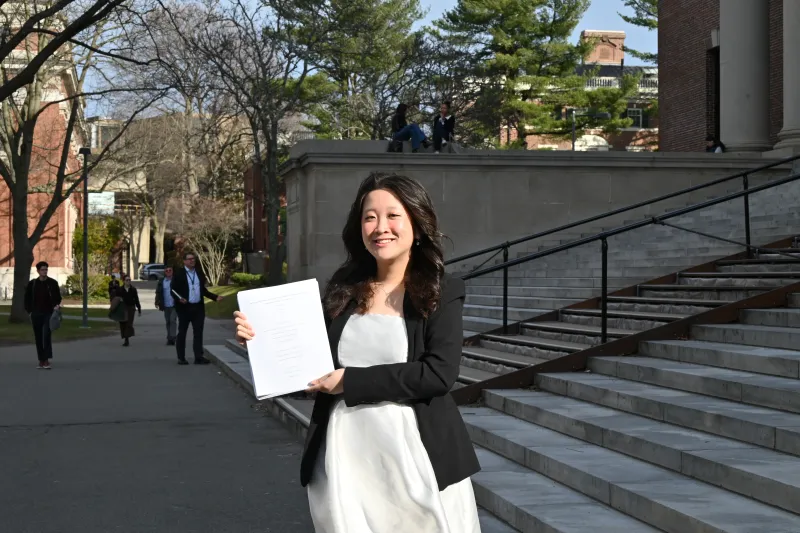
Each day in class, Oneli Perera ’26 sits among peers who, in another context, might never have met—and that reality drives her research.
In her senior thesis, “Does Proximity Foster Community? A Mixed-Methods Analysis of the Impact of Multi-Ethnic Classrooms on Inter-Ethnic Engagement in Sri Lankan Universities,” Perera explored the possibility of multiethnic classrooms serving as modes for social harmony in post-civil war Sri Lanka. As an Economics and Sociology concentrator, Perera is curious about the link that ties people and social interactions together, because to unify a country, one must understand the communities that constitute it.
Born and raised in Sri Lanka, Perera witnessed the ethnic division present in all aspects of life. Though the civil war between the Tamils and the Sinhalese ended in 2009, to Perera, “the issues that led to the conflict have still to be addressed,” and sharp divisions between the groups remained with little to no opportunities for merging.
Some courses in Sri Lankan universities created opportunities for these groups to interact with one another, sparking Perera’s interest in “understanding how the creation of these spaces could lead to community building.”
Guided by the sociology department, her advisor Shai Dromi, Associate Senior Lecturer on Sociology, and supported by the Harvard College Resource Program, she developed her ideas and the thesis’ quantitative and qualitative aspects.
Although she initially desired to collect her data in person in Sri Lanka, travel issues forced her to gather as much information about the relationships within these multiethnic classrooms from afar. After coordinating schedules and balancing time zones, she interviewed 31 students virtually and collected 386 surveys online from students in Sri Lankan universities.
Perera’s findings are that mixed-ethnic classrooms created friendships across ethnic lines, but these interactions were limited, and a fundamental gap existed regarding perspectives of historical events. In addition, Muslim students showed a higher rate of friendships with students of the Sinhalese majority than with their own ethnic group, and seemed to want to take advantage of the opportunities for social mixing that university life presents. However, Tamil students did not have the same reaction, despite both having relatively similar population sizes to Sri Lanka. These relationships indicated that creating mixed educational spaces fosters community across ethnic groups, yet there are still “tangible barriers that hinder these relationships between groups,” she said.
“Just creating space is not enough.”
She believes the unresolved issues arising from the civil war also need to be addressed.
For Perera, the research ultimately reinforced a larger lesson: proximity alone cannot create understanding, but creating spaces for dialogue and shared experience can open the door to it.
Through her future work in educational inclusivity, she hopes to “contribute to learning that keeps the world inclusive and makes places equitable,” and continue exploring how institutions can help build communities where diverse people not only coexist, but truly value differences and learn from one another.