Alert: Office Closure
The Admissions & Financial Aid Office will be closed on Monday, October 12 for Columbus Day (Federal)/Indigenous People’s Day (City of Cambridge). We will reopen with normal business hours on return Tuesday, October 13.
Last Updated: October 09, 5:01pm

Senior Thesis Creates Healthcare Feedback System
Communication has always been the thread tying the story of Lani Tran ’26 together.
For her senior thesis in biomedical engineering, Tran turned that concept into action by designing a collaborative feedback system that helps healthcare providers improve patient care. Originally from the small town of Alhambra, California, Tran arrived at Harvard with an inkling that she wanted to pursue science. “I love how sciences are this concept that seems abstract but can be tangible,” Tran described. However, it wasn’t the equations or the experiments that ultimately captured her interest, but rather the act of sharing it. “You realize science is all around us, and it's one of those subjects that you can teach anyone,” she remarked.
That passion for making science accessible and understandable shaped the rest of her Harvard career.
Growing up in an underserved school system, she didn’t have many opportunities to explore research, so that sector of science felt distant. Everything changed after watching her peers and teachers dive into their own projects. “Seeing the passion from everyone else, and how people can go really deep into a field, I started to go, ‘okay, I want to pursue research.’”
When Tran first began thinking about her senior thesis topic, the direction wasn’t immediately clear, but as she considered her day-to-day experiences, she noticed a repetitive issue. In her role at CrimsonEMS, a student-run emergency medical service on campus, Tran spends her shifts responding to medical calls and caring for patients alongside other student EMTS. In that environment, one principle was constantly emphasized: feedback. After every shift, EMS members fill out a Continuous Quality Improvement (CQI) report, reflecting on what went well and what workers could have done differently. The goal is simple — to maintain high standards of care and ensure that responders are always learning from their past experiences.
“A huge part of being an EMT is feedback. I was really interested in this aspect of the feedback system of EMS, because it seems really simple—let's learn from mistakes.”
As a pre-med student, Tran noticed a stark contrast in the hospitals she worked at. “When you go to the hospital, specifically in the emergency department and the ICU, a lot of hospitals don't have any feedback system at all,” she noted. The lack of structured feedback can create gaps in communication between providers in different departments, leading to missed opportunities to reflect, improve, and strengthen patient care. Tran began to wonder whether parts of the problem were the absence of an integrated system that made feedback easy and routine.
Tran’s principal investigator, Christina Cifra MD, Assistant Professor of Pediatrics at Harvard Medical School and Attending Physician in the Division of Medical Critical Care at Boston Children’s Hospital, had observed similar challenges while working at a hospital in Iowa, where she helped develop a system aimed at improving communication between care teams. Under Cifra’s support and guidance, Tran aspired to create a similar system for Boston Children’s Hospital. The goal was to build a feedback tool that could be embedded directly into the hospital’s electronic health record platform, Epic. By integrating the system into software clinicians already used, the design was aimed to make sending feedback rapid and intuitive—allowing physicians and care teams to communicate across departments without adding additional burdens to their already demanding workflow.
After months of hard work, the first iteration of this system was produced. Clinicians could submit feedback within Epic and send it directly to the appropriate healthcare worker, although early testing showed that usability was still a challenge. Tran hit a roadblock after conducting qualitative interviews with clinicians and assessing quantitative metrics.
Building off of Cifra’s previous work in Iowa, the most time-consuming aspect of the feedback system is having the receiving ICU physician identify the correct referring Emergency Department physician to send feedback to. “It’s also tedious things that a computer could do—[such as discover] who to send it to,” she described. “This patient came from who? From where?”
In response, Tran refined the system. The pilot iteration introduced automated features so that feedback letters already had the appropriate recipient identified, streamlining the process and significantly improving the platform’s usability. While the system has not yet been fully automated, Tran has temporarily routed submissions through herself, manually directing feedback to the correct physicians to test whether reducing logistical barriers would make clinicians more likely to use the platform.
Improving Patient Outcomes, One Step At A Time
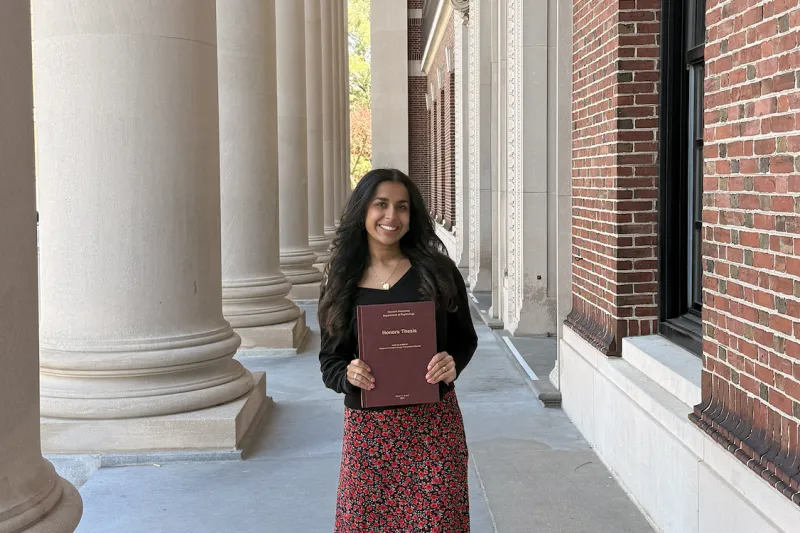
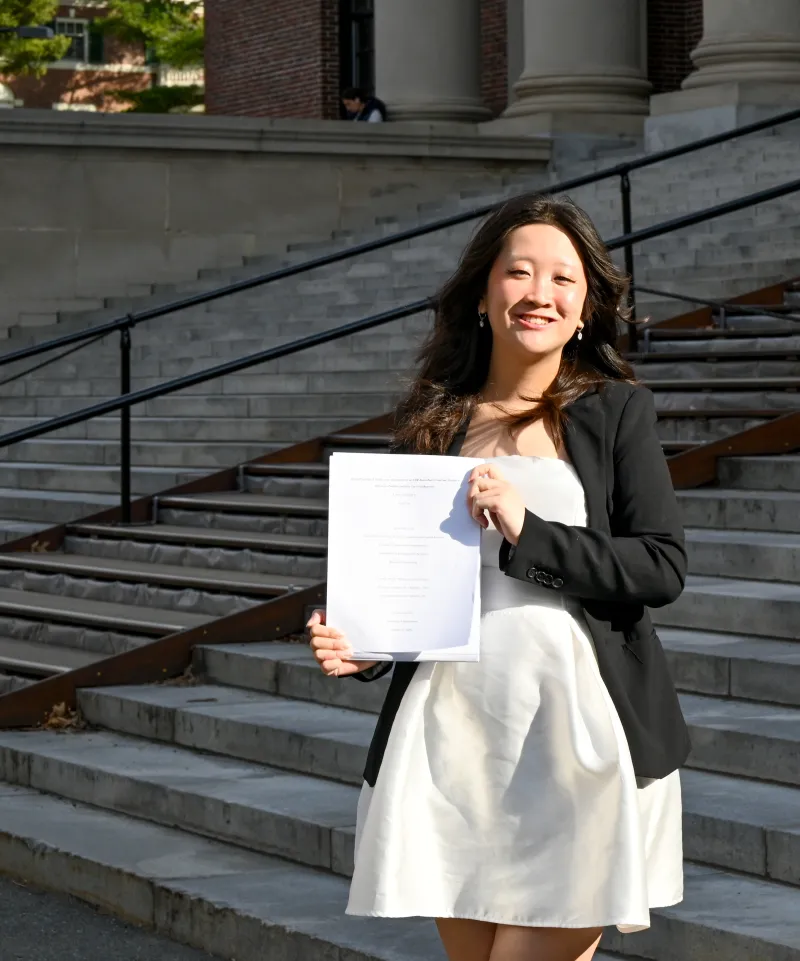
Tran '26 holds up her completed thesis on the steps of Widener Library, celebrating a project that made a difference for the local community. Photo by Jeffrey Yang '26.
So far, early results have been promising. “This actually helps a lot with what we call the System Usability Scale (SUS),” she described.
Looking ahead, Tran hopes to continue innovating and take this project even further. Future versions of the system may incorporate artificial intelligence to help automatically identify patterns in feedback, pull information from clinician notes to help auto-fill feedback letters, and streamline communication between clinicians. “The goal is that we're able to pitch this to stakeholders, to get this to as many hospitals as possible,” she declared, “especially in communities who aren't thinking about these things.”
Her thesis process, similar to the feedback system she built, was full of adjustments, missteps, and revisions. But for Tran, that’s part of the beauty of research. “You should always expect the unexpected and be prepared to make adjustments,” she stated. Next year, Tran will attend the Harvard Graduate School of Education, where she hopes to continue exploring the intersection of science and teaching that first drew her into the field.
If there’s one lesson she hopes others take away from her story, it’s that the path of science rarely begins in one place—or follows a single route. “You can come from anywhere,” she shared. “And you can come from a place of, ‘I'm not sure; I'm worried about making mistakes,’ to being okay with making mistakes—and wanting to change that culture.”