Alert: Office Closure
The Admissions & Financial Aid Office will be closed on Monday, October 12 for Columbus Day (Federal)/Indigenous People’s Day (City of Cambridge). We will reopen with normal business hours on return Tuesday, October 13.
Last Updated: October 09, 5:01pm

Challenging Thought Through Thesis
Throughout her Harvard College experience, Social Studies and Philosophy concentrator Ari Kohn ‘26 has explored how the mission of Harvard College, to educate citizen and citizen-leaders through a liberal arts education, is enacted and preserved.
The motivation behind her senior thesis, “Citizen or Citizen-Leader: Civic Thought Programs and the Trust Crisis in American Higher Education”, began as a first-year student in the aftermath of the pandemic, when Kohn witnessed difficulties in defining what an undergraduate institution should be. From this, she began to consider a university’s role in establishing trust and credibility to ultimately provide a meaningful education for students.
Kohn engaged in the subject further through multiple extracurricular programs at Harvard. “I've been very involved in the Intellectual Vitality Initiative, the Mindich Program in Engaged Scholarship, and Honor Council,” Kohn said.
“I care a lot about answering the question, ‘what does it take to make knowledge meaningful for communities beyond campus?’”
Kohn’s thesis focused on the creation of over 38 Civic Thought Programs (CTPs) at both public and private research universities over the past decade, and sought to answer the question: what do [CTPs] view as the source of declining trust in higher education, and what is their intervention?
Although not able to explore every aspect of the topic, Kohn enjoyed going in depth on what she considered a prolific avenue to restore trust in higher education as leaders for the common good. During her research, she conducted 18 interviews with faculty, students and administrators of Civic Thought Programs at eight universities, three of which she visited in person.
Her process entailed in-depth examinations of these programs, the variations in forms, and motivations behind their emergence. To do this, Kohn embarked on multi-dimensional research pathways. She examined the exigence behind the creation of these programs, looking at cases both where they resulted from mandated state-legislation, or from philanthropic or presidential initiatives. She combined faculty and administrator interviews with a qualitative analysis of informational materials and included her own experiences from site visits.
To better understand CTP’s stated intervention to “educate for self-government,” Kohn drew on her joint philosophy concentration to interpret the significance of the common pedagogical practices she observed in her interviews and site visits. She applied concepts from Hannah Arendt’s writings on thinking and judgment as a framework, connecting practices such as “pre-disciplinary inquiry,” and “first-person normative assignment” to forming key capacities for self-government. Kohn was able to identify specific instances where institutional leaders explicitly referenced Arendt’s political conceptions with shared responsibility, allowing her to connect the work she was exposed to in the classroom to the real-world decisions made to build CTPs. Kohn concluded that CTPs do in fact offer a plausible approach to addressing the problem.
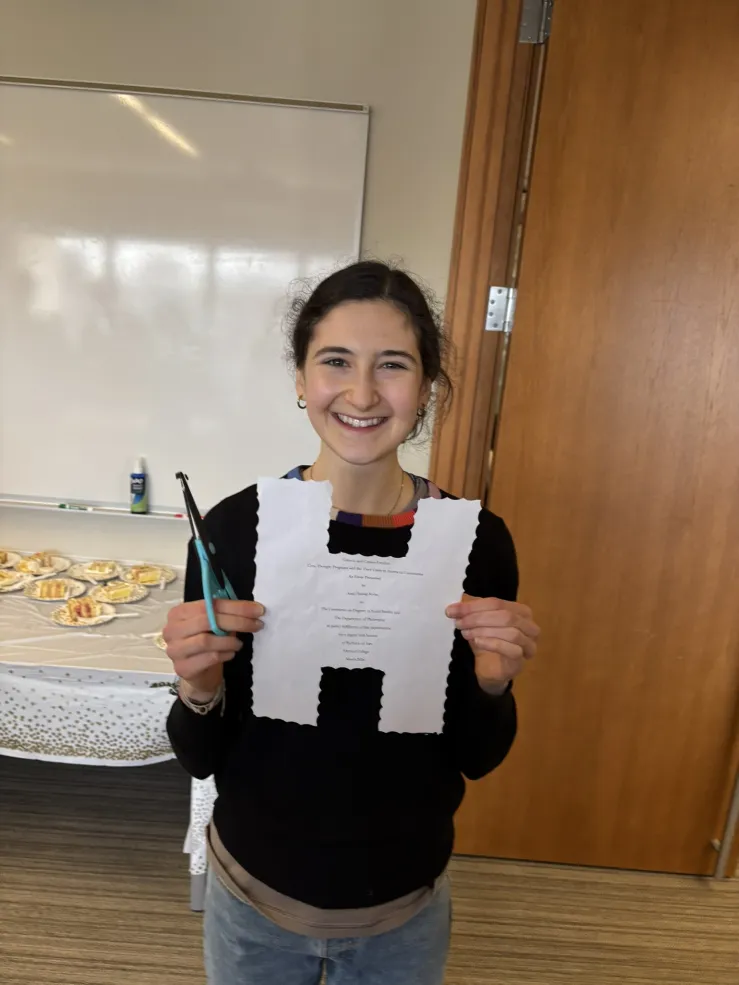
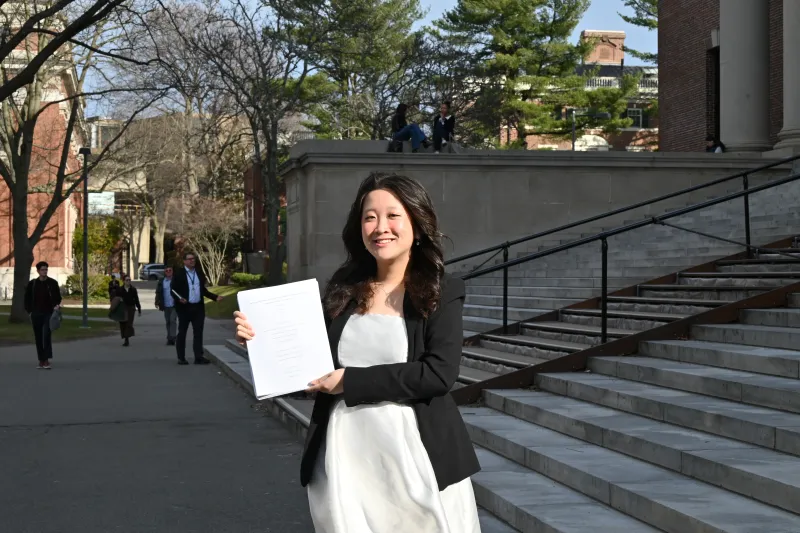
Kohn proudly held up a picture of her thesis title page, cut into an "H" shape for Harvard.
Kohn believes her work will help proponents and skeptics understand the motivation and aims of CTPs as a response to a problem shared by all higher education.
“How can we use these programs to understand at a deeper level, [to contribute to] the survival, the sustainability of higher education, and use these schools as a tool to do so?” Kohn said.
Kohn noted that her thesis would not have been possible without her Harvard resources and support network. She received financial support from numerous grants, including the Center for American Political Studies (CAPS), Harvard College Research Program (HCRP), the Lester Kissel Grant in Practical Ethics, and others. She used this funding to visit CTPs and to attend various conferences on Civic Thought around the country.
Institutional support from faculty and advisors served an equally important role. Kohn’s thesis was jointly advised by Dr. Sarah Greenberg, Social Studies Lecturer, and Dr. Ned Hall, Director of Undergraduate Studies and Norman E. Vuilleumier Professor of Philosophy. She also credited multiple professors in helping to critically examine the topic, including Danielle Allen, James Bryant Conant University Professor, Julie Reuben, Charles Warren Professor of the History of American Education, and Rakesh Khurana, Professor of Sociology, Marvin Bower Professor of Leadership Development and former Danoff Dean of Harvard College.
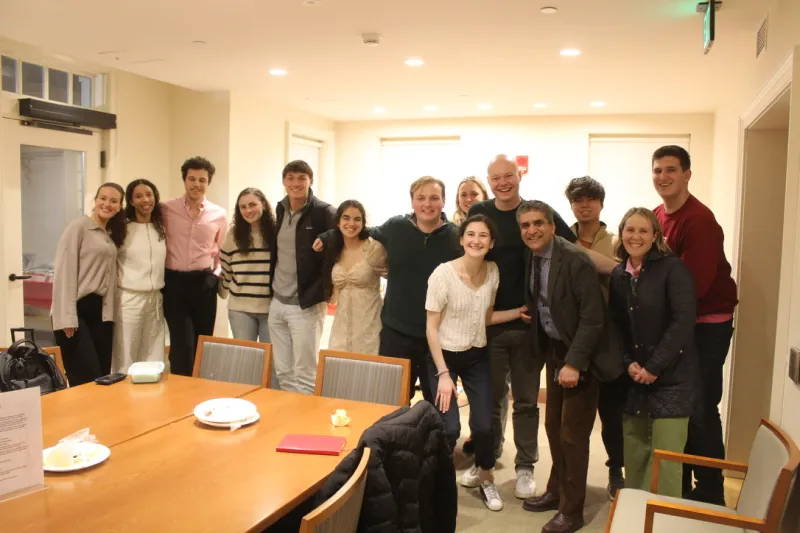
Kohn greatly valued her time working with the Intellectual Vitality Initiative, pictured here with the IV Board and Rakesh Khurana.
After graduation, she will continue her research on trust in higher education at Harvard.
“I feel so lucky that [my thesis] has turned into my job next year,” Kohn said.