Alert: Office Closure
The Admissions & Financial Aid Office will be closed on Monday, October 12 for Columbus Day (Federal)/Indigenous People’s Day (City of Cambridge). We will reopen with normal business hours on return Tuesday, October 13.
Last Updated: October 09, 5:01pm

From Rugby Pitch to Lab Bench
Tiahna Padilla ’26 has never been afraid of a challenge.
As an Engineering concentrator and captain of the Women's Rugby team, Padilla spent four years proving to herself and everyone around her that excellence in one area can fuel another. While working on her senior thesis, the two worlds she inhabited at Harvard converged through the development of a mobile artificial limb that gives unique insight into the capabilities of athletes’ muscles.
Building From Balloons and Sound Waves
Padilla's thesis may emulate science fiction at first glance: how to test a medical device designed to see inside the human body, without actually using a human body?
Her answer is a phantom — an artificial stand-in for human tissue that mimics the way real biological material looks and behaves under ultrasound. Ultrasound imaging works by sending sound waves into the body and reading how they bounce back. Different tissues — fat, skin, muscle — each reflect and absorb those waves differently. To test an ultrasound device accurately, material that behaves exactly like the real thing is needed.
What makes Padilla's phantom different from others is its mobility. Most existing phantoms are static; remaining still so a device can scan them. Padilla's is dynamic, designed to simulate a muscle contracting and relaxing. At its core is what she calls a “muscle balloon”, a layered structure of tissue-mimicking materials with a hollow cavity inside. A water pump pushes fluid in and out of that cavity, inflating it to mimic a muscle flexing, and deflating it to mimic one relaxing.
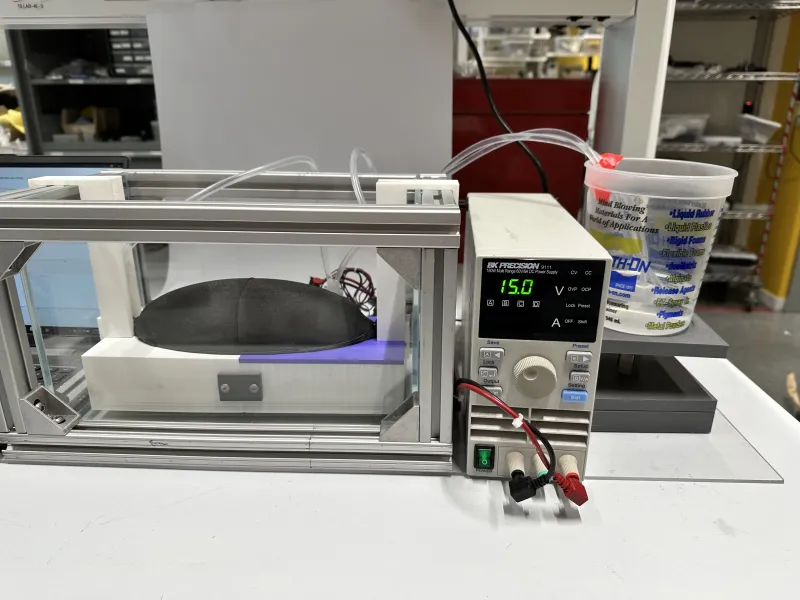
Limb Brought To Life
Padilla’s dynamic phantom limb, attached to its water pump. Photo by Lauren Fabiszak.
The phantom was built to validate the work of her thesis advisor, PhD candidate Umut Civici, who is developing a new kind of wearable ultrasound device. Traditional ultrasound machines use an array of crystals to generate a wide image. His design uses a single-element sensor that is smaller and lighter to wear, making it ideal for studying how athletes' bodies move in real time. Before trusting a new device to read biological tissue accurately, however, ensuring its capacity to function under controlled properties is essential. Thus, Padilla's phantom comes in. "You know exactly how [a phantom] should move,” she said.
For Padilla, who has spent years thinking about how her own body performs under pressure, the connection was immediate. Wearable ultrasound technology “is really great for learning more about biomechanics, and how we move, and why we move in that way,” she explained. The idea of using her engineering skills to better understand athletes like herself is precisely what drew her to the project.
A Learning Curve and Captain’s Instinct
Padilla's biggest test came with the first prototype. Before matching the acoustic properties of real tissue, she needed to know whether the mechanical concept would work. “There's a lot of ifs,” she recalled. “Are the water pumps going to leak? Is it really going to make the cyclical motion we want?”
Her solution originated from an engineer’s instinct of building and testing. “The best way to get around that, as engineers should know, is just a prototype to see how it goes,” she said. Her first attempt succeeded exactly how she anticipated.
The breakthrough brought with it a familiar feeling from the rugby field. “It just felt like everything coming together; a culmination of all the processes that come with engineering and project design,” she said. With increased confidence about where the project could go next, she immediately set her sights on taking it further. “You always want to do more and make it better,” she said.
Her drive to strive towards bigger goals, Padilla believes, is sharpened by rugby. Last year, as co-captain of a thirty-person team, she spent a lot of energy thinking about how to align people with very different personalities toward a single shared goal. She sees a direct parallel in engineering design, “where you really like ideating and thinking about the best solution to problems before you try them,” she said. “It's very similar to how you might approach sports culture and how you might want to rally people together.”
The satisfaction of a team breakthrough and a research breakthrough also have parellels, “where you realize that your hard work is paying off, because of these real, tangible results,” she said.
Looking Ahead
After graduating from Harvard, Padilla will head back to her homestate of California to pursue a master's degree, with an eye on the intersection of medical devices and biomechanics. For students watching Padilla and wondering if they, too, could balance a varsity sport and an intensive engineering thesis, she has a clear message that begins long before any lab work or practice schedule.
“Not counting yourself out before you start — I think that's a huge thing,” she said. Through every major life transition growing up, she developed a tendency to talk herself out of hard things before she tried it.
Now, Padilla’s advice mimics her engineering philosophy: prototype first, then adjust. "You can always make adjustments on the go,” she said, “just backing yourself and knowing that you're capable of way more than you think you are.”